Suppose you connect four lamps in one loop, with long wires between them. When you close the switch, will the nearest lamp light first, followed by the others like a very slow celebration? In an ordinary classroom circuit, they appear to light together. Electrons already exist throughout the wires, and an electrical change spreads around the circuit rapidly. Testing this puzzle helps us distinguish electron movement from the transfer of energy. It also gives us a reason to examine complete paths, component symbols, current measurement, and useful circuit designs.
In the News
Britons urged to dig out unwanted electricals to tackle copper shortage — The Guardian, 08 October 2024. A study estimated that unused and broken electrical items in the United Kingdom contained about 38,449 tonnes of copper. Recovering this metal could help supply new wiring. The report connects everyday cables with the materials needed for larger electrical systems.
South Korea says battery pack is possible cause of Air Busan fire — Reuters, 14 March 2025. Investigators reported that a power bank might have started the January aircraft fire after insulation inside its battery broke down. This was an interim finding, not a final conclusion. It illustrates why unwanted conducting paths inside batteries can be dangerous.
Tesla recalls 10,500 Powerwall 2 batteries in US over fire risk — Reuters, 13 November 2025. Tesla announced a recall after receiving 22 reports of overheating. These home batteries can store energy from solar panels and provide backup power. The report shows that useful energy storage still requires careful component design and protection against overheating.
What do you think?
1] Why might a new torch remain dark even after you replace its battery?
2] Why does a lamp need a return connection to its power source?
3] What might happen if a connection touches only the plastic covering of a wire?
4] How can a small finger movement control a lamp across a room?
5] Why might a device work when you hold its cable at a particular angle?
6] How could you warn someone who cannot hear a doorbell?
7] What could a warning light do that a loud sound cannot?
8] Why might several lights go out when only one part breaks?
9] How could you find the cause of a fault without replacing everything?
10] Why can a simple drawing be more useful than a detailed photograph?
11] What would make instructions understandable to someone who speaks another language?
12] Why might a tiny lamp become hot as well as bright?
13] What might explain lights appearing to start together despite long connecting wires?
14] Why should a measuring tool become part of the path it is checking?
15] Why might two drawings look different but describe the same arrangement?
16] What could go wrong if two exposed metal parts touch accidentally?
17] Why might adding more lamps make each one dimmer?
18] When would you want several warning devices to respond to one switch?
19] What should you investigate before deciding that a dim lamp needs a new battery?
20] Why might an old cable be worth recycling rather than throwing away?
Did You Know?
1] J. J. Thomson identified the electron in 1897. People had built working electrical devices before they understood this particle.
2] In ordinary copper circuits, an electrical signal can travel enormously faster than the average drift of individual electrons. Exact speeds depend on the circuit.
3] Researchers reported in 2019 that Volta’s electric eel could produce a discharge of up to 860 volts. It uses electrical discharges to help capture prey; charge can move through water containing dissolved ions.
4] Moving a lamp symbol from the left side to the right side of a drawing does not change the circuit if all the electrical connections remain the same.
Vocabulary
- conducting path — 전하가 흐를 수 있는 길
- chemical energy — 화학 에너지
- transfer energy — 에너지를 전달하다
- surroundings — 주변 환경
- copper — 구리
- plastic covering — 플라스틱 피복
- exposed metal — 피복 없이 드러난 금속
- loose connection — 느슨한 연결
- continuous — 끊어지지 않고 이어진
- metal contacts — 금속 접점
- push switch — 누름 스위치
- filament — 전구 안에서 빛을 내는 가는 금속선
- operating limits — 안전하게 작동할 수 있는 범위
- current-limiting component — 전류의 크기를 제한하는 부품
- attract — 끌어당기다
- repel — 밀어내다
- drift — 한쪽 방향으로 서서히 이동하다
- steady — 일정하게 유지되는
- prediction — 예상
- electrical signal — 전기 신호
- friction — 마찰
- junction — 전선이 갈라지거나 만나는 연결점
- terminal — 전기 연결 단자
- range — 측정 범위
- brightness — 밝기
- visible warning — 눈으로 볼 수 있는 경고
- audible warning — 소리로 들을 수 있는 경고
- fault finding — 고장 원인 찾기
- resistance — 전하의 흐름을 방해하는 성질
- recycling — 재활용
Glossary
Electric charge — Charge is a property of particles. It can be positive or negative. Electrons have negative charge. 전하.
Electron — An electron is a tiny particle found in atoms. It has negative charge. Some electrons in metals can move through the material. 전자.
Electric current — Current describes how much charge passes a point each second. Its unit is the ampere. A lamp transfers energy without using up current. 전류.
Cell — A cell transfers energy through chemical processes when it supplies a circuit. It has positive and negative terminals. It does not store a supply of current. 전지.
Conductor — A conductor allows electric charge to move through it easily. Copper is a useful example. In a copper wire, mobile electrons carry charge. 도체.
Insulator — An insulator strongly limits charge movement under normal conditions. Plastic is a common example. Insulation helps prevent unwanted conducting paths. 절연체.
Series circuit — A series circuit has one path through its components. The steady current is the same throughout that path. A gap anywhere in the path stops sustained current around the loop. 직렬 회로.
Parallel circuit — A parallel circuit has separate branches between shared connection points. Different branch currents can have different sizes. A break in one branch need not stop current in another. 병렬 회로.
Ammeter — An ammeter measures electric current. It must be placed in series with the component being measured. Connecting it directly across a cell can allow a dangerously large current. 전류계.
Circuit diagram — A circuit diagram uses symbols to show components and connections. A straight line usually represents a wire. The connections matter more than a symbol’s position on the page. 회로도.
Cells, wires, switches, and lamps
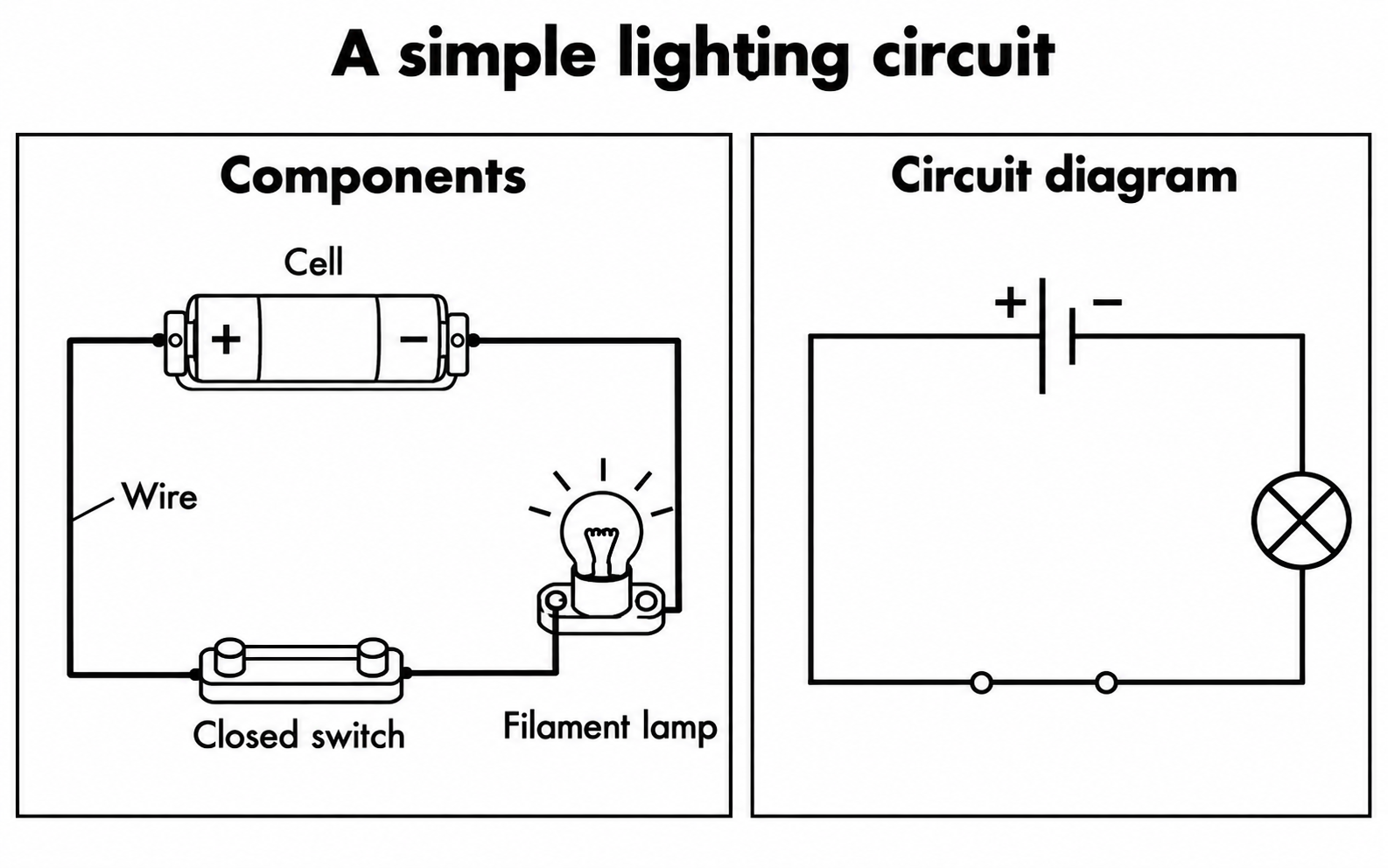
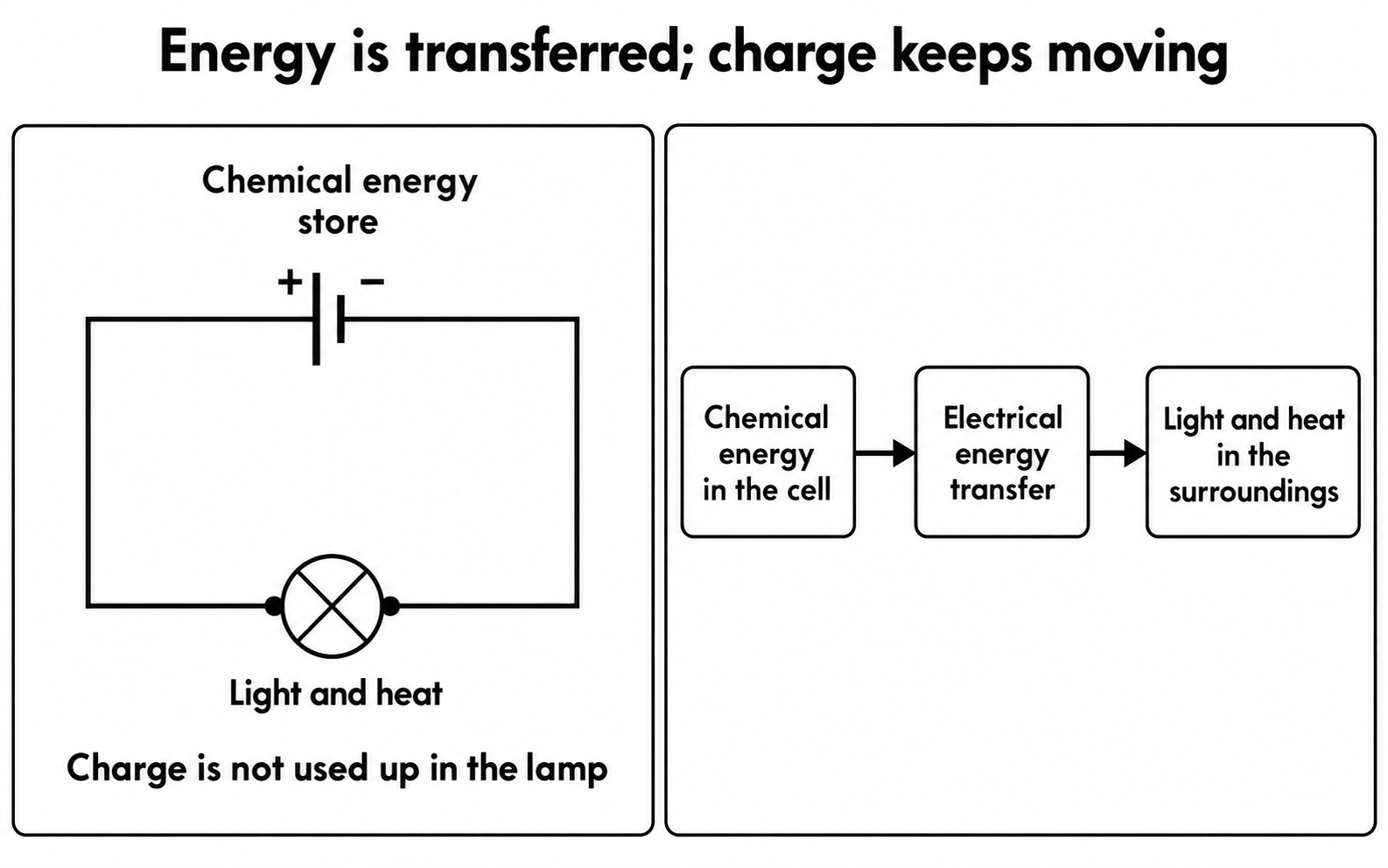
A simple lighting circuit needs a cell, conducting wires, a switch, and a suitable lamp. A cell stores chemical energy. When the circuit operates, chemical reactions in the cell help transfer energy electrically to the lamp. The lamp transfers energy to its surroundings as light and heat. A battery contains connected cells, although everyday speech also calls a single cell a battery. Neither a cell nor a battery stores a supply of electric current. Current exists when charge flows. In our classroom model, use a cell holder and a small filament lamp chosen by the teacher.
1] What energy store does the cell use?
2] Why is it incorrect to say that a cell stores current?
Video: How batteries work — Adam Jacobson, TED-Ed
A wire provides a conducting path between components. Copper is useful because some electrons in the metal can move through it. The plastic covering around a typical wire is an insulator: it strongly limits charge movement through the covering under normal conditions. A wire must make contact through its exposed metal ends, not through its plastic covering. A loose connection can interrupt the path even when the pieces appear to touch. Check the connection points carefully before replacing a lamp or cell. A circuit can fail because of an ordinary gap, without anything dramatic having broken inside a component.
1] Why must a connection touch exposed metal rather than plastic?
2] What should you check before replacing a lamp that does not light?
A switch controls a circuit by making or breaking a conducting connection. In a closed switch, metal contacts touch and complete the path. In an open switch, the contacts separate and leave a gap. Closing a switch does not create electrons, and opening it does not remove electrons from the wires. Instead, the switch controls whether there is a continuous path for a sustained current. A push switch can complete the path only while someone presses it. This makes it useful for a doorbell: the visitor requests attention without leaving the building permanently announcing their arrival.
1] How does closing a switch change the conducting path?
2] Why is a push switch useful for a doorbell?
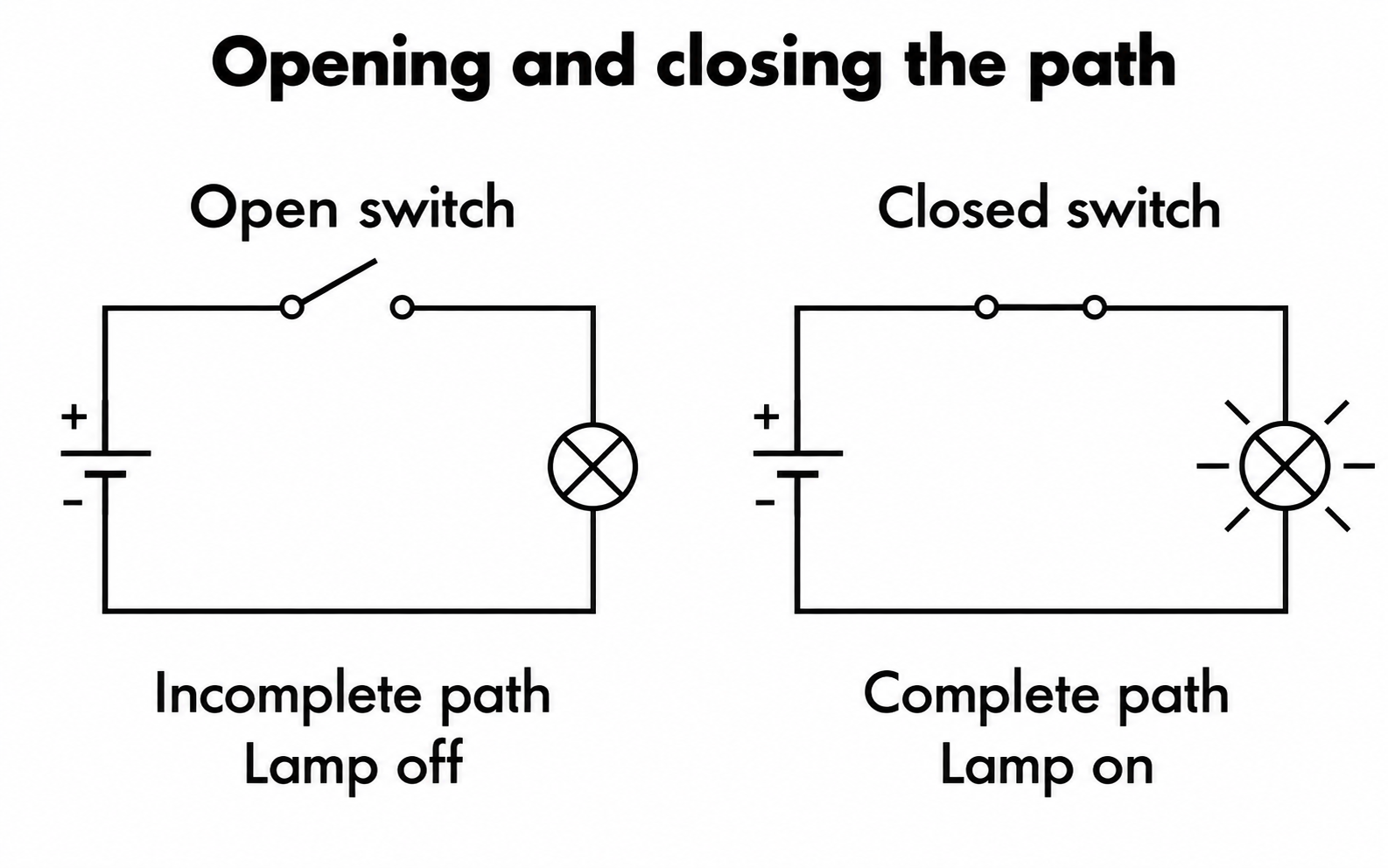
A lamp and a buzzer produce different useful outputs. A filament lamp contains a thin wire that becomes hot enough to glow when a suitable current passes through it. A buzzer transfers some electrical energy into sound. Components have operating limits, so the teacher must choose a supply suitable for each one. An LED is another type of light source, but it behaves differently from a filament lamp and usually needs a suitable current-limiting component. For this lesson, use filament lamps unless instructed otherwise. Never assume that every small light can safely replace every other small light.
1] What useful outputs do a lamp and buzzer produce?
2] Why should you ask before replacing a filament lamp with an LED?
Testing current and explaining electron flow
An electron is a tiny particle with a negative electric charge. Atoms contain electrons, and metal wires already contain mobile electrons before a cell is connected. Opposite charges attract, while like charges repel. In a working direct-current circuit, electrons drift through the external metal path from the cell’s negative terminal toward its positive terminal. Their motion remains irregular, with a small average drift in one direction. They do not march in perfect straight lines. Conventional current is defined in the opposite direction: from positive to negative through the external circuit. It describes the direction positive charge would move.
1] Where are mobile electrons before the cell is connected?
2] How does electron drift differ from conventional current direction?
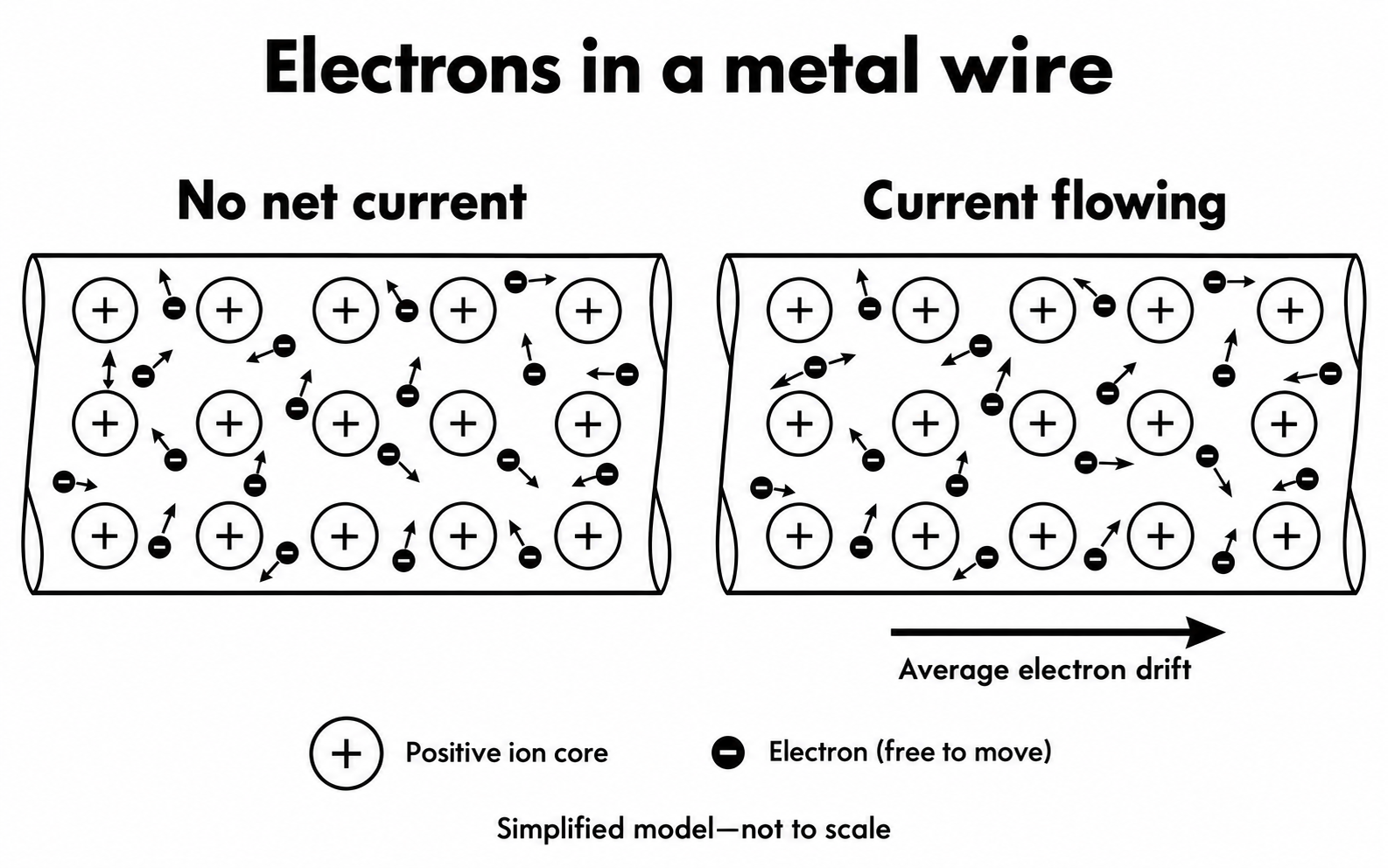
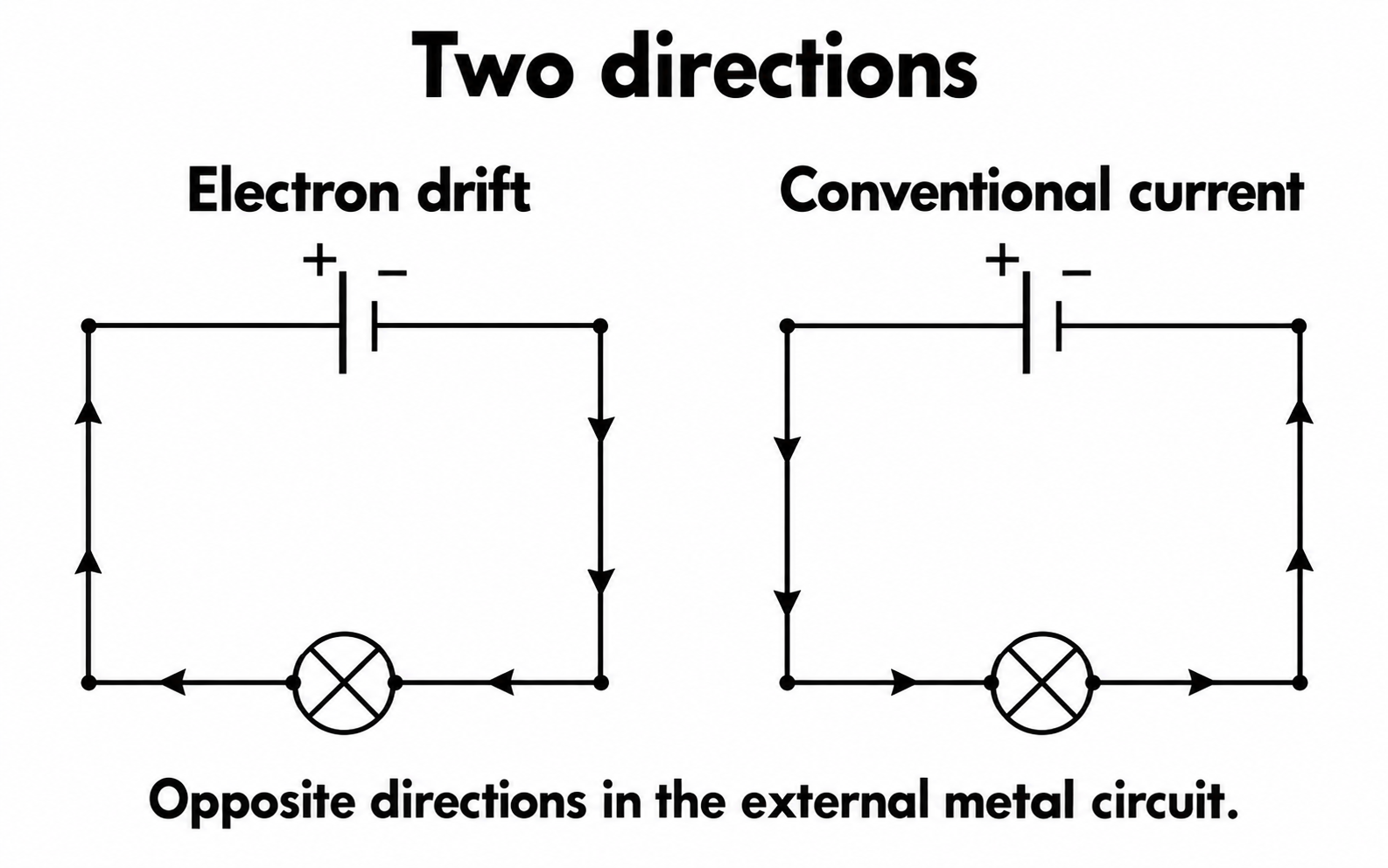
Electric current describes how much electric charge passes a point each second. Its unit is the ampere, written A. In a single complete loop, called a series circuit, the steady current is the same at every point. A lamp transfers energy, but it does not use up charge or consume current. To test this, a teacher can measure current before and after the lamp with an ammeter. The readings should agree within the limits of the equipment. A battery eventually becomes unable to maintain the required energy transfer because its chemical condition changes, not because the wires run out of electrons.
1] Why should the current before and after a lamp be the same?
2] Why does a battery eventually stop operating the lamp satisfactorily?
Consider four suitable filament lamps connected in one loop, with several metres of wire between them. Predict whether they will light in a visible sequence when the switch closes. Then test the prediction using a teacher-approved supply. They should appear to light together if the supply can operate all four lamps. The electrical change spreads rapidly through the circuit, while individual electrons drift much more slowly. The response is not perfectly instantaneous, but its travel time across a classroom is too short for our eyes to resolve. The experiment therefore does not show that electrons race from the cell to each lamp.
1] What observation would support the prediction that the lamps appear to light together?
2] Why does this observation not prove that electrons move rapidly from lamp to lamp?
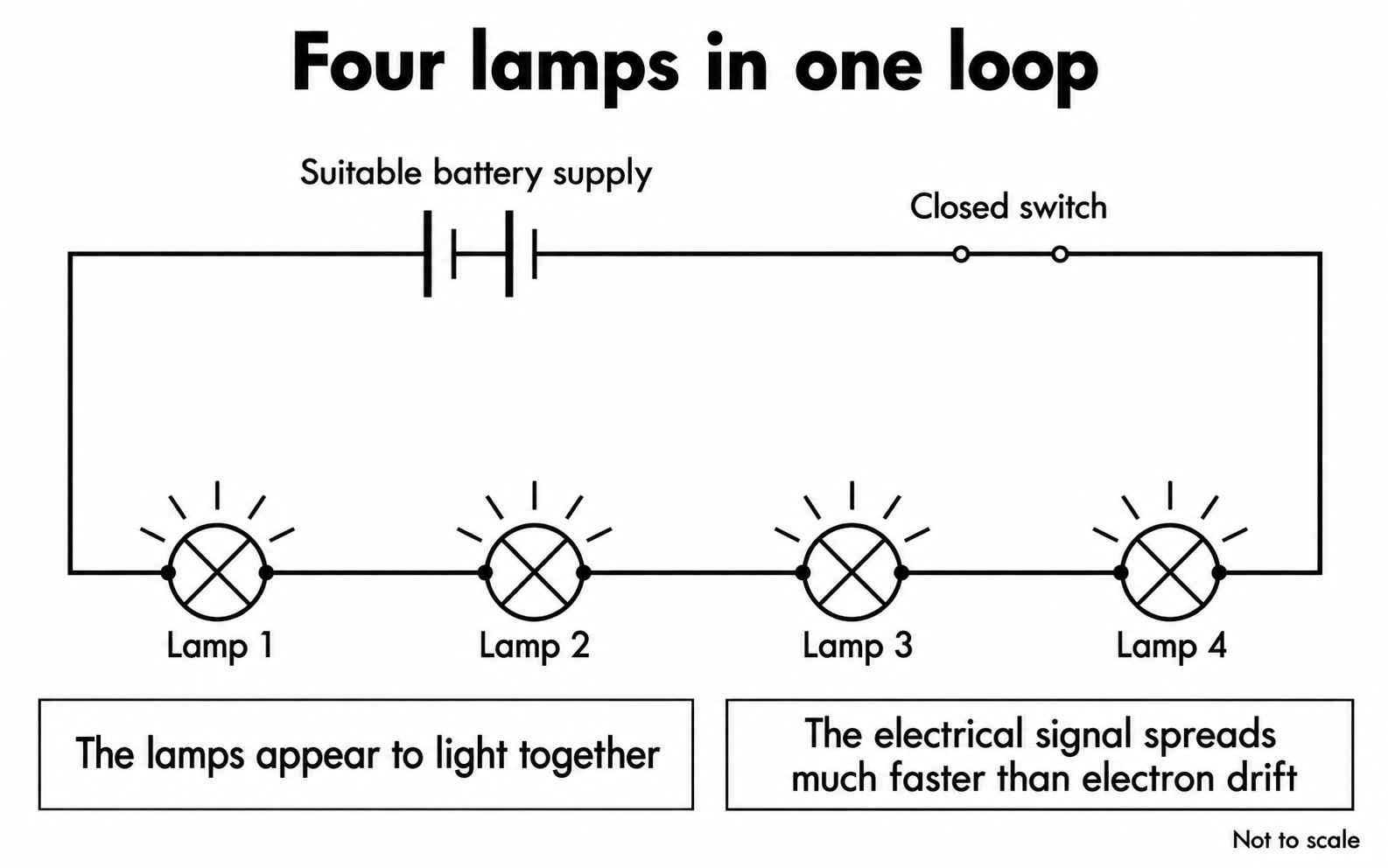
A loop of string can model charge movement in a series circuit. Several students hold the loop loosely while one student pulls it slowly around. Marks on the string represent charges already distributed around the path. The pulling student represents the cell, and another student can represent a lamp by gently resisting the moving string. All parts of the taut loop move together. However, electrons are not tied to a string, and a real electrical signal takes time to spread. Keep the string loose enough to move safely, and never pull it quickly through anyone’s hands because friction can cause burns.
1] What do the marks and pulling student represent?
2] What is one scientific limitation of the string model?
Drawing and comparing circuit diagrams
A circuit diagram shows electrical connections using symbols instead of realistic pictures. A cell symbol has two parallel lines: the longer line represents the positive terminal, and the shorter line represents the negative terminal. A filament lamp is shown as a circle containing a cross. An ammeter is shown as a circle containing A. Open and closed switch symbols show whether their contacts connect. For a buzzer, use the same curved sounder symbol throughout this lesson and label it clearly. Standard symbols help readers recognise components, although some symbol styles vary between countries and technical standards.
1] Which line in a cell symbol represents the positive terminal?
2] How can you identify a lamp and an ammeter from their symbols?
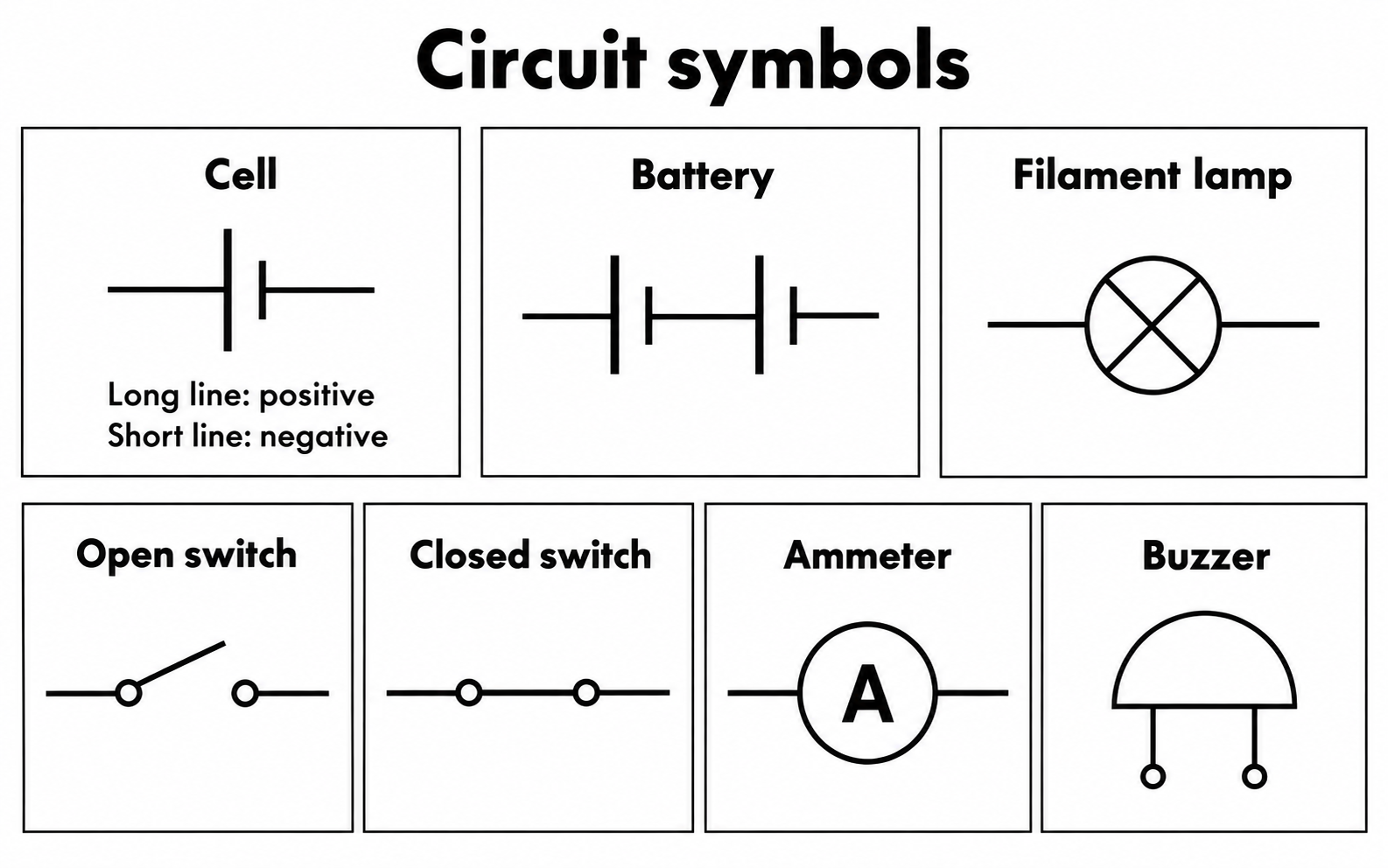
Draw connecting wires as clear, straight lines, usually with square corners. Join each line to the correct connection point on a symbol. Do not continue a wire through the middle of a lamp or ammeter symbol, because this can hide the intended connection. An accidental gap can make a drawing show an open circuit. At a junction, a filled dot shows that wires connect. For these classroom diagrams, avoid crossings that do not connect. Finally, trace a complete route from one cell terminal, through the intended components, and back to the other terminal. This check often reveals missing connections immediately.
1] Why should wires meet symbols without accidental gaps?
2] What does a filled dot at a junction mean?
To measure current through a lamp, connect an ammeter in series with that lamp. Open the switch before changing the connections. Insert the meter into the path so charge passing through the lamp also passes through the meter. For a direct-current meter, follow the teacher’s instructions for the correct sockets, range, and terminal direction. Begin with an appropriate high range when using a manually selected range. Never connect an ammeter directly across a cell’s terminals: its low resistance can allow a dangerously large current. A meter measures current at its position, rather than collecting or storing the moving electrons.
1] Where must an ammeter be connected to measure current through a lamp?
2] Why must you avoid connecting an ammeter directly across a cell?
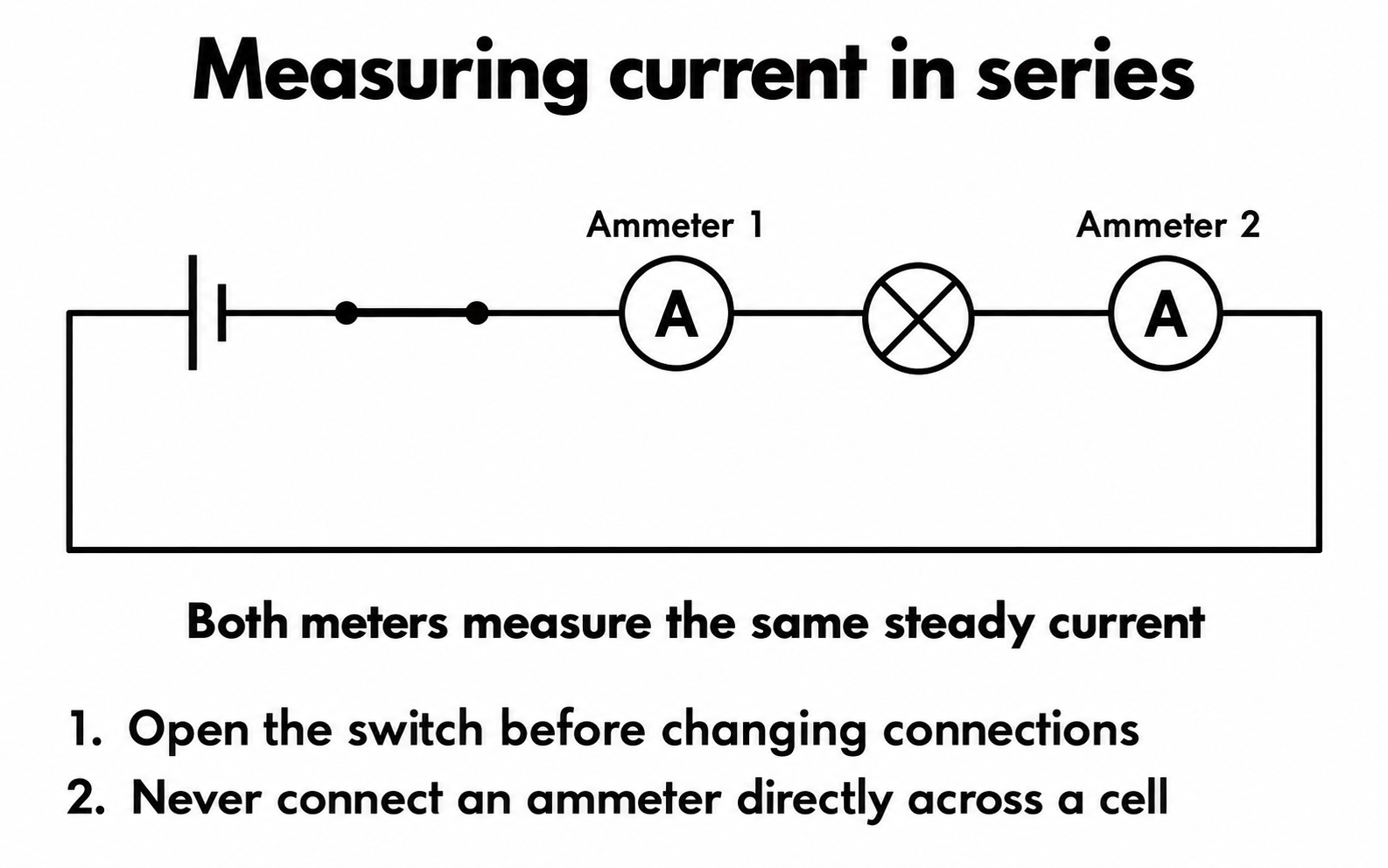
Two diagrams can look different while showing the same electrical connections. A lamp drawn on the left of a page can still have exactly the same role as one drawn on the right. Component order in a simple series loop does not create extra paths. To compare diagrams, list the components and trace how their terminals connect. A circuit containing a cell, switch, and buzzer can produce sound when closed. Adding an ammeter in series allows current measurement. Replacing the buzzer with a lamp changes the output. Adding a separate branch changes the connections and may change how the components operate.
1] How can you decide whether two differently arranged drawings represent the same circuit?
2] How would replacing a buzzer with a lamp change the useful output?
Designing reliable lighting and alarm circuits
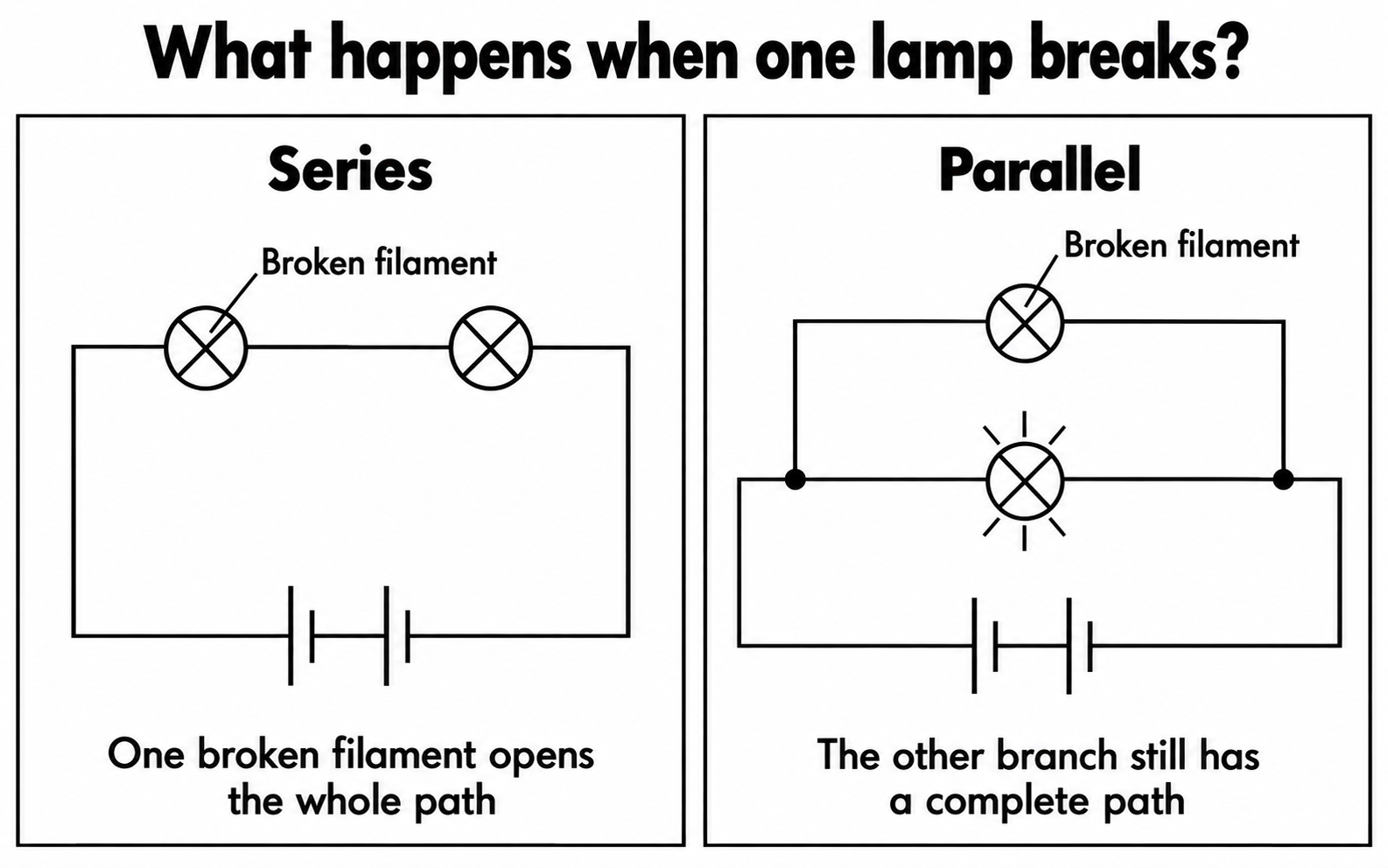
A series lighting circuit has one path through all its lamps. One switch anywhere in that path can turn them all on or off. However, if a filament breaks and creates a gap, every lamp in that loop goes out. Adding identical lamps in series to the same suitable supply usually makes each lamp dimmer because the circuit current decreases. This makes a series circuit useful for studying shared current, but often unsuitable for independent room lighting. Real lighting systems commonly use parallel branches, which provide separate paths. A single failed lamp then need not break the paths through the other lamps.
1] Why do all the lamps go out when one filament breaks in a series loop?
2] Why are parallel branches useful for independent room lighting?
A simple alarm can use one switch to control both a lamp and a buzzer. Connecting them in separate parallel branches allows each branch to connect across the supply when the main switch closes. The teacher must select components with suitable operating requirements. The lamp gives a visible warning, while the buzzer gives an audible warning. These outputs serve different needs: a person may not hear a buzzer in a noisy room or may not see a lamp from another room. A classroom alarm demonstrates these ideas, but it is not a tested safety device suitable for protecting a building.
1] How does the main switch control both alarm branches?
2] Why might an alarm need both visible and audible warnings?
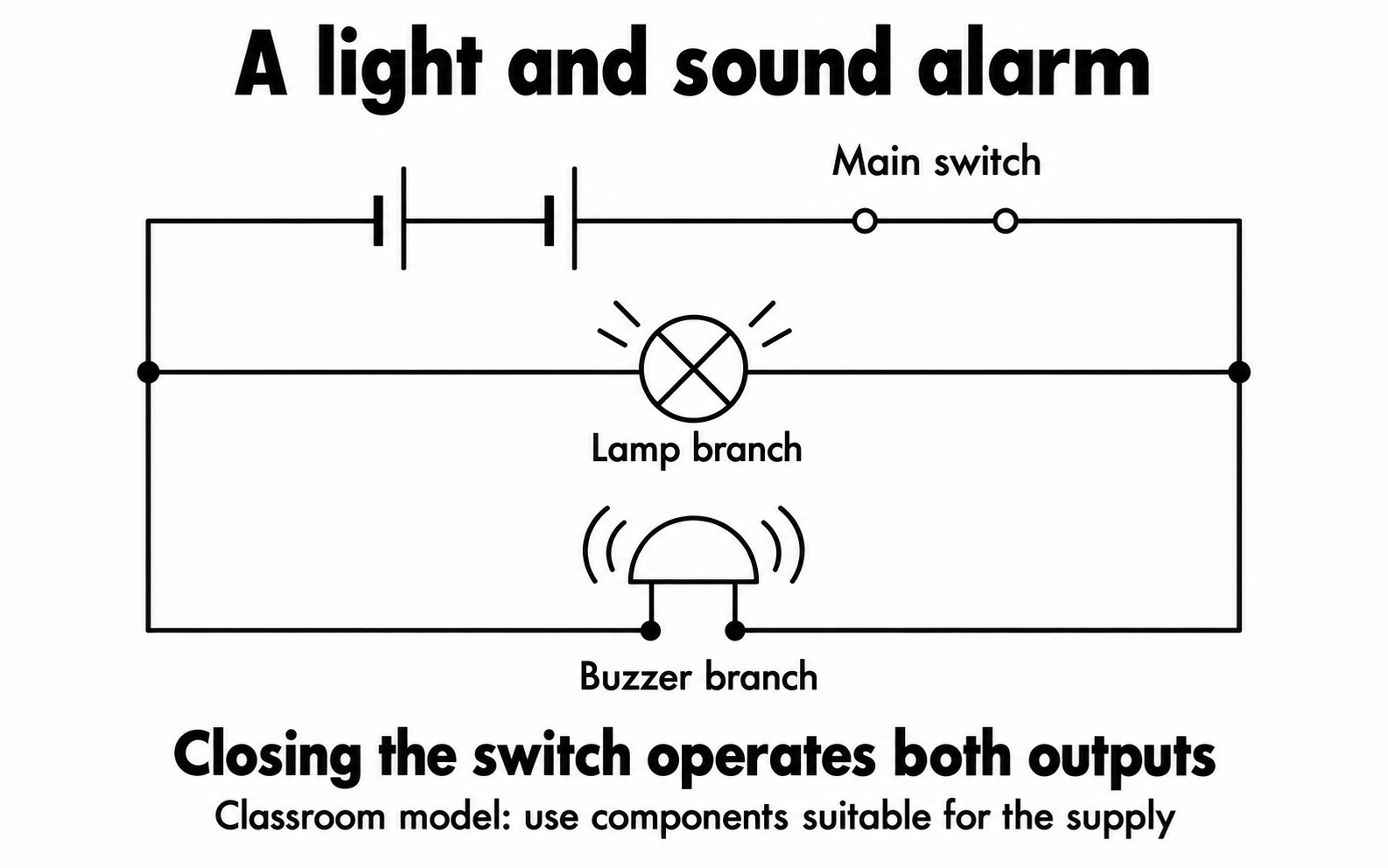
Reliable circuits need systematic fault finding. Open the switch, then inspect the cell holder, exposed wire ends, and component connections. Change one suspected faulty component at a time so that the result identifies a likely cause. A lamp that stays dark may have a broken filament, a loose connection, or an unsuitable supply. Dim light alone cannot prove that a cell is nearly exhausted, because several faults can reduce brightness. Future designs may use sensors and automatic checks to report failures, but extra electronics also need power and can fail. Reliability depends on good connections, suitable components, and careful testing.
1] Why should you change only one suspected faulty component at a time?
2] Why does a dim lamp not prove that the cell is nearly exhausted?
A short circuit is an unintended path with very low resistance that can bypass a useful component. It may allow a large current, heating wires or the cell. Never join a cell’s terminals directly with a wire, and never deliberately build a short circuit. Use only teacher-approved low-voltage equipment; do not experiment with wall sockets, damaged batteries, or unknown power supplies. Stop and tell the teacher if equipment becomes hot or smells unusual. Protecting the plastic insulation helps prevent unwanted connections. When equipment reaches the end of its useful life, proper recycling can recover valuable metals such as copper.
1] How can a short circuit cause heating?
2] What should you do if classroom equipment becomes hot or smells unusual?
Homework
Writing tasks
1] Write approximately one page explaining why a new torch might remain dark. Discuss the cell, lamp, switch, and connections, and give a sensible order for checking them.
2] Write approximately one page explaining how a switch controls a lamp. Describe open and closed contacts, the conducting path, and what happens to electrons already in the wires.
3] Write approximately one page explaining why several lamps may appear to light together. Distinguish electron drift from the spread of the electrical change, and explain what the classroom experiment cannot prove.
4] Write approximately one page arguing whether circuit diagrams are more useful than photographs for building circuits. Discuss standard symbols, clear connections, and one situation in which a photograph helps.
5] Write approximately one page explaining how to design a warning for people with different needs. Discuss visible and audible signals, suitable components, and the limits of a classroom model.
6] Write approximately one page comparing series and parallel lighting. Explain what happens when one filament breaks and recommend an arrangement for independent room lights.
7] Write approximately one page explaining why a lamp produces heat as well as light. Describe energy transfer and explain why charge is not used up.
8] Write approximately one page explaining how an ammeter helps investigate a circuit. Describe its position, what it measures, and why a direct connection across a cell is unsafe.
9] Write approximately one page arguing against replacing a battery immediately whenever a lamp becomes dim. Discuss alternative causes and describe checks that could provide better evidence.
10] Write approximately one page arguing whether schools should collect unwanted cables for proper recycling. Discuss useful materials, collection arrangements, and why damaged batteries require separate adult handling.
Debate topics
1] Should every school door alarm include both a light and a buzzer?
Side A — Yes, because: 1) people have different hearing and vision needs; 2) noisy rooms can hide sounds; 3) two outputs can attract attention in different ways.
Side B — No, because: 1) some locations need only a simple arrival signal; 2) additional components cost money and require maintenance; 3) an assessment of the location may identify a more suitable design.
2] Should students learn circuit symbols before building their first simple circuit?
Side A — Yes, because: 1) a diagram gives clear instructions; 2) recognising components helps prevent connection errors; 3) shared symbols make group discussion easier.
Side B — No, because: 1) handling real components gives the symbols meaning; 2) a teacher can guide a first safe build without a diagram; 3) students can compare their physical circuit with a diagram afterwards.
3] Should a school repair suitable low-voltage teaching equipment before buying replacements?
Side A — Yes, because: 1) replacing a loose connection may restore the equipment; 2) repair can reduce material waste; 3) suitable repairs may cost less than replacement.
Side B — No, because: 1) repeated failures can waste teaching time; 2) reliable repairs may require unavailable expertise; 3) replacement may be preferable when damage affects safety or dependable operation.
Test questions
Answer the following questions in full sentences. If you don’t know the right answer, add a (?) mark, and later we can look at it together.
1] What energy store does a cell use when supplying a circuit?
2] How does a battery differ from a single cell in scientific terminology?
3] Why is copper useful inside a connecting wire?
4] What is the purpose of the plastic insulation around a wire?
5] How does an open switch differ from a closed switch?
6] How does a filament lamp produce light?
7] What charge does an electron have, and how do opposite charges interact?
8] In which direction do electrons drift through the external metal path of a working cell-powered circuit?
9] What does current describe, and what is its unit?
10] Why should current measurements on either side of a lamp agree in a steady series circuit?
11] Why can classroom lamps appear to light together even though electrons drift slowly?
12] What does the string-loop model represent well, and what is one limitation?
13] How do the two lines in a cell symbol identify its terminals?
14] How can you distinguish a lamp symbol from an ammeter symbol?
15] What does a filled dot at a wire junction show?
16] How should an ammeter be connected to measure current through a lamp?
17] Why can two differently shaped circuit diagrams represent the same circuit?
18] How does a broken filament affect series lighting compared with parallel lighting?
19] How can one switch control a lamp and buzzer in separate branches?
20] What is a short circuit, and what should you do if classroom equipment becomes hot or smells unusual?
Teaching illustrations and similes
1] Complete path — A circular walking track needs an unbroken route for continuous laps. Limit: electrons are already distributed throughout a wire; they do not queue only at the cell.
2] Switch — A removable bridge can join or separate two parts of a route. Limit: charges do not pile up indefinitely at an open classroom switch.
3] Charge and energy — A reusable delivery cart can move goods without itself being consumed. Limit: electrical energy is not a physical parcel carried inside each electron.
4] Electron drift and signal — People in a line can respond to a message long before one person walks the entire line. Limit: an electrical signal spreads through electromagnetic interactions, not spoken instructions.
5] Equal series current — Marks on a moving string pass every point of a taut loop at the same rate. Limit: electrons are not mechanically tied together, and real circuits take time to respond.
6] Insulation — A protective sleeve helps keep a wire’s metal away from other conductors. Limit: insulation has operating limits and cannot prevent every possible electrical failure.
7] Standard symbols — Map symbols identify features without realistic portraits of buildings. Limit: a circuit diagram shows electrical connections rather than exact physical positions or distances.
8] Ammeter placement — A counter at a doorway records what passes that doorway. Limit: an ammeter does not store charge, and it slightly changes the circuit it measures.
9] Parallel branches — Separate routes between shared meeting points allow movement along one route when another closes. Limit: branch currents need not be equal, and the supply must support the connected components.
10] Fault finding — Checking one suspect at a time makes evidence easier to interpret. Limit: a real circuit can contain more than one fault, so one successful repair may not solve everything.