1] When you first meet a classmate, what makes you decide you might get along well with them?
2] Why do you think people like taking personality quizzes?
3] If someone says “I’m an ISTJ”, what might you assume about them?
4] How might your personality show differently in the classroom versus at home?
5] If you take a personality quiz now and then again next year, do you think you’ll get the same result?
6] Are some personality “types” better suited for certain hobbies? Why might that be true — or not true?
7] If a company uses personality tests to hire people, what do you think would be good or bad about it?
8] If you were designing a personality quiz, what kinds of questions would you include?
Questions to think about:
- Do you know about MBTI?
- Have you taken a test before? How many times? Where?
- If they are not using the MBTI system, what other ways do people use to understand each other?
- What affect has it had on culture and society around you?
- Do you think the MBTI test is useful?
Vocabulary
- Trait – a quality or feature that describes a person’s character. 특징: 사람의 성격을 설명하는 성질이나 특징.
- Preference – a natural liking or choice for one thing over another. 선호: 다른 것보다 더 좋아하거나 선택하는 경향.
- Tendency – a usual way of behaving or thinking. 경향: 습관적으로 행동하거나 생각하는 방식.
- Introvert – a person who feels comfortable alone or in quiet places. 내향적인 사람: 혼자 있거나 조용한 환경을 좋아하는 사람.
- Extrovert – a person who feels happiest when with other people. 외향적인 사람: 다른 사람들과 있을 때 가장 즐거운 사람.
- Empathy – the ability to understand or share another person’s feelings. 공감: 다른 사람의 감정을 이해하거나 함께 느끼는 능력.
- Logic – clear, reasonable thinking based on facts. 논리: 사실에 근거해 명확하고 합리적으로 생각하는 것.
- Decision-making – the act of choosing between options or ideas. 의사결정: 여러 선택 중 하나를 고르는 행동.
- Perception – the way you see or understand something. 인식: 어떤 것을 보는 방식이나 이해하는 방법.
- Category – a group of things with similar qualities. 범주: 비슷한 성질을 가진 것들의 모임.
- Pigeonholing – putting people into narrow categories that may not fit them. 고정관념화: 사람을 지나치게 단순한 틀에 넣는 것.
- Horoscope – a prediction about someone’s personality or future based on birth date or stars. 운세: 태어난 날이나 별자리를 바탕으로 한 성격·미래 예측.
- Compatibility – the ability of two people or things to exist or work well together. 궁합 / 양립성: 함께 잘 지내거나 작동할 수 있는 성질.
- Compromise – an agreement where each side gives up part of what they want. 타협: 서로 조금씩 양보해 합의에 이르는 것.
- Flexible – able to change easily or adapt to new situations. 유연한: 새로운 상황에 맞게 쉽게 바뀌는.
- Fixed – not changing or able to change. 고정된: 변하지 않거나 바뀔 수 없는.
- Interpret – to explain or understand the meaning of something. 해석하다: 어떤 것의 의미를 설명하거나 이해하다.
- Contrast – a clear difference between two things. 대조: 두 가지 사이의 뚜렷한 차이.
- Influence – to affect how someone thinks or behaves. 영향을 주다: 누군가의 생각이나 행동에 영향을 미치다.
- Define – to explain exactly what something means. 정의하다: 어떤 의미를 명확히 설명하다.
- Identify – to recognize or say who or what someone is. 식별하다: 누구인지, 무엇인지 알아내다.
- Reflect – to think carefully, or to show an image of something. 반영하다 / 숙고하다: 어떤 것을 비추거나 깊이 생각하다.
- Variety – many different kinds of things. 다양성: 여러 종류가 함께 존재하는 것.
- Psychiatrist – a doctor who treats mental or emotional problems. 정신과 의사: 마음이나 정신 문제를 치료하는 의사.
- Altruistic – caring more about other people’s needs than your own. 이타적인: 자기보다 남을 먼저 생각하는.
- Eager – full of interest or excitement to do something. 열정적인 / 열망하는: 무엇인가를 하고 싶어하는 마음이 강한.
- Tendencies – ways of behaving that often repeat over time. 성향: 일정하게 반복되는 행동이나 생각의 방식.
- Compatibility – how well people or systems work together. 궁합: 함께 잘 지내거나 작동하는 정도.
- Compromise – a middle solution reached through mutual agreement. 타협: 서로 양보하여 합의하는 것.
- Preference (MBTI) – in MBTI, one of two choices that best fits how you naturally think or act. 선호(엠비티아이): 자신이 자연스럽게 행동하거나 생각하는 두 선택 중 하나.
- Accurate – correct and true in every detail. 정확한: 사실에 맞고 틀림없는.
- Skeptical – not easily convinced; having doubts. 회의적인: 쉽게 믿지 않고 의심하는.
- Reliable – able to be trusted or depended on. 신뢰할 수 있는: 믿을 수 있고 의지할 수 있는.
MBTI – What is it?
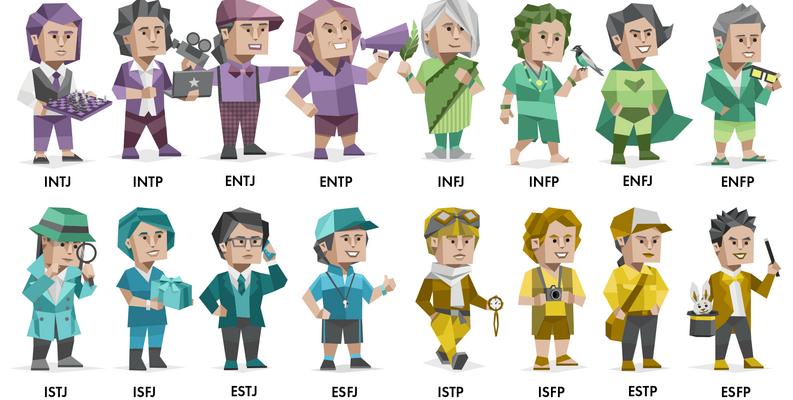
MBTI, short for Myers-Briggs Type Indicator, is a personality assessment tool that helps people understand their individual preferences and tendencies. It’s based on the idea that there are various ways people perceive the world and make decisions. By answering a series of questions, individuals are assigned one of 16 distinct personality types, each represented by a four-letter combination, such as INFP or ESTJ. It’s not about labeling or pigeonholing people, but rather gaining insights into our natural inclinations. *
In recent years, MBTI has gained significant popularity, becoming a widespread topic of interest in various circles, from workplaces and social settings to online communities. People have found it fascinating to explore and talk about their personality types, and it has influenced how we perceive ourselves and interact with others.
[*] Hahahahaha. This is a big fat lie – of course its about labelling and pigeonholing. Useful, but not perfect.
Before MBTI, various personality theories existed, but none gained the same level of popularity and widespread application.
Inside the MBTI
If you’ve ever wondered why your best friend can’t stop talking while you run out of words after lunch, congratulations — you’ve met psychology in its natural habitat. People have always tried to explain why we’re all so wonderfully different. The ancient Greeks blamed it on body fluids (which sounds gross but was their best guess). Centuries later, the Myers-Briggs Type Indicator, or MBTI, arrived to offer a tidier explanation. It says we all fall somewhere among four simple pairs: Extravert or Introvert, Sensing or Intuitive, Thinking or Feeling, Judging or Perceiving. Combine one from each pair and you get a four-letter code, like a secret password for your personality. Of course, real people are messier than tests — more watercolor than blueprint — but MBTI gave millions a way to talk about themselves without using the phrase “it’s complicated.”
1] Why do you think people like systems that explain who they are?
2] How could MBTI make people feel seen or understood?
3] What danger might come from believing the system too much?
The Extraversion–Introversion pair might be the most famous. Extroverts collect energy from being around people. They are the human equivalent of solar panels, charging up when surrounded by chatter. Introverts are battery-powered; they need quiet to recharge. It’s not about shyness — it’s about energy management. The trouble is, the world tends to reward talkers, so introverts often feel pressure to “act outgoing.” Extroverts, meanwhile, can get unfairly labelled as noisy. MBTI’s greatest gift might be reminding both sides that the other isn’t broken — just wired differently.
4] How could this idea help you understand classmates better?
5] What might make introverts and extroverts misunderstand each other?
6] Why is it useful to know how you recharge?
Next come Sensing and Intuition — two different ways of noticing the world. Sensors trust facts and details. They’d make good detectives: sharp eyes, careful notes, no nonsense. Intuitives prefer patterns and ideas; they’d notice the detective’s mood rather than the footprints. Then there’s Thinking and Feeling — how we decide. Thinkers follow logic, while Feelers listen to values and empathy. If you’ve ever argued over whether to “follow your heart” or “be reasonable,” you’ve already met these two in battle. Most of us use both, depending on the day, the weather, and how much sleep we’ve had.
7] How might a team benefit from having both Thinkers and Feelers?
8] Which pair do you think you use more — Sensing or Intuition?
9] How could knowing this change how you study or work?
Finally, Judging and Perceiving deal with how we face daily life. Judging types like things settled: checklists, deadlines, finished projects. They are the ones who colour-code their school folders. Perceiving types live more like jazz — flexible, unplanned, creative in the moment. They might start homework late but somehow finish with flair. Both ways work. The world would be unbearable if everyone demanded plans, and chaotic if no one did. It’s the mix that keeps things interesting — one person holds the map while the other finds the shortcut.
10] What kind of person are you — the planner or the improviser?
11] How can different approaches make a team stronger?
12] Why do we need both order and flexibility in life?
How We See and Judge the World
If you’ve ever argued with a friend about whether pineapple belongs on pizza, you already understand personality theory. Two people can look at the same thing and see completely different worlds. MBTI tries to map those differences — how we notice, decide, and react. Some people focus on what’s right in front of them: the facts, the taste, the crust. Others jump to the big picture: what it means about society that anyone eats pineapple at all. Neither is wrong; they’re just seeing with different lenses. The problem starts when we assume our lens is the only one that works.
Personality, of course, isn’t frozen like a popsicle. It bends with time, culture, and experience. The MBTI gives you a snapshot, not a passport. You change every year — even every morning — depending on who you’re with and what life hands you. Online, the test has turned into a meme machine, where people excuse anything by saying, “That’s just my type.” Funny, yes, but the real point isn’t to defend your habits; it’s to understand them. MBTI is best used the way salt is used in cooking — a sprinkle adds flavor, but too much ruins the meal.
Questions
1] Why do people often see the same situation in different ways?
2] What might happen if you believed your MBTI label too strongly?
3] How can joking about personality types actually help people understand each other?
The 16 Types Explained Simply
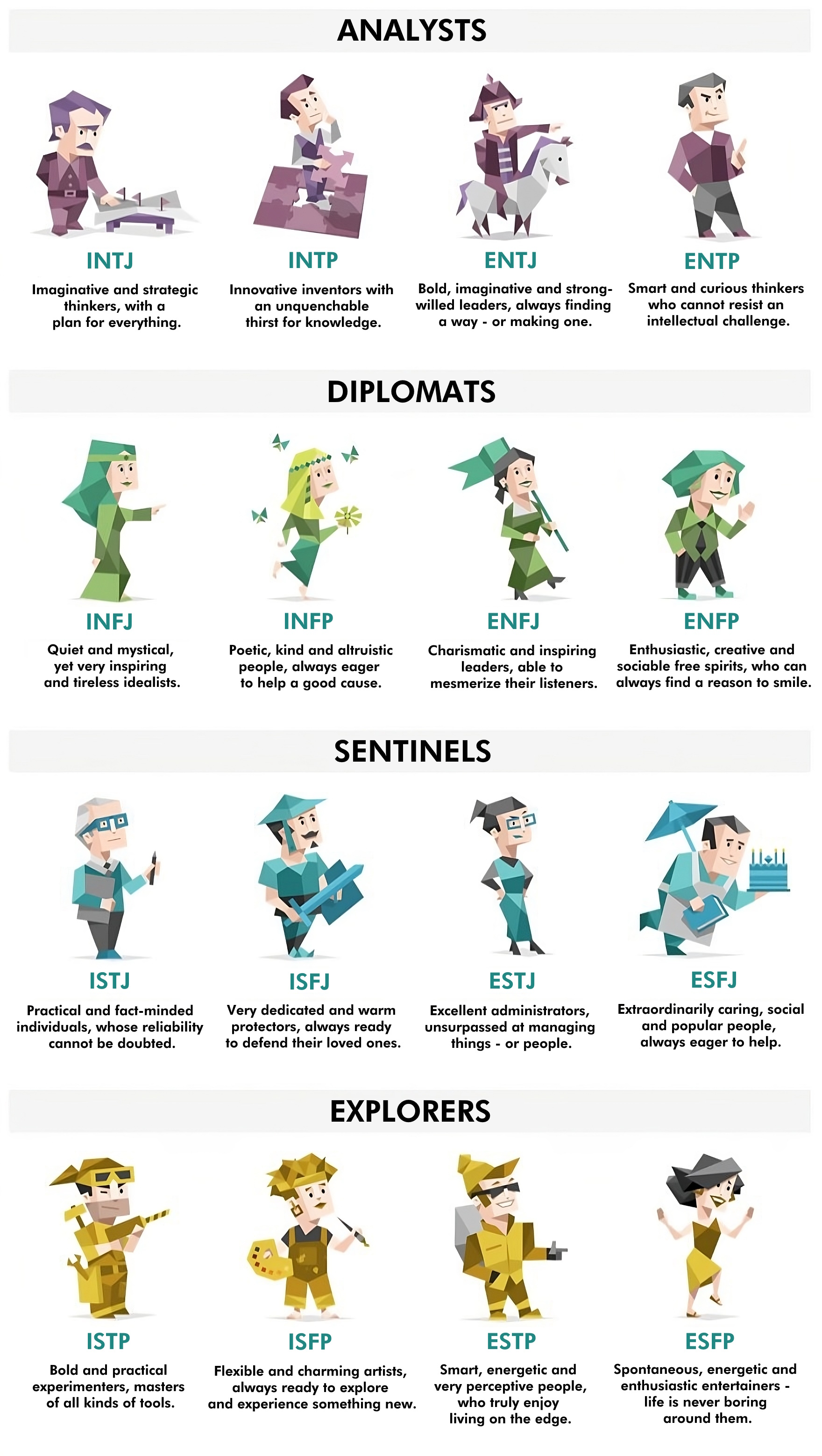
Imagine sorting the entire human race into sixteen boxes. That’s what the MBTI attempts — an act of optimism so large it’s almost adorable. The idea is simple: everyone answers a bunch of questions about habits, feelings, and choices, and out pops a four-letter summary of your mind. “INTJ,” “ESFP,” “INFP” — they sound like secret codes, but each one tells a short story about how a person gathers energy, notices the world, makes decisions, and organizes life.
Each type has its own flavor. ESTJs like rules and plans; ENFPs chase ideas like balloons. ISFJs are the quiet helpers who remember everyone’s birthday; INTPs are the ones who forget their own. ENTJs want to run the show; ISFPs would rather paint it. It’s a cast of characters that together covers just about every kind of human you’ve ever met — and several you hope to. What makes it fun isn’t deciding which type is “best,” but noticing how completely different personalities can still get along in the same classroom or family.
Of course, no one fits a single box perfectly. You might read two descriptions and think, “I’m both of those — plus a bit of chaos.” That’s fine. Personality isn’t a cage; it’s a weather forecast. Sometimes you’re sunny and organized, sometimes cloudy and forgetful. The labels are there to start the conversation, not to lock the door.
So if you ever wonder what the point of the sixteen types really is, it’s this: they remind us that people don’t all think the same way — and that’s a very good thing. It’s the reason group projects sometimes fail spectacularly, and the same reason they sometimes work like magic.
Questions
1] How can knowing the 16 types help people understand each other better?
2] Why might no one fit perfectly into just one type?
3] What makes personality variety useful in real life?
What MBTI Gets Right—and Wrong
The MBTI gets one big thing right: people are different, and that difference matters. It gives names to things we’ve always noticed — why one person loves small talk and another loves small rooms, why some plan for everything and others don’t plan lunch. By handing us a vocabulary for personality, it helps us talk about ourselves without turning it into a therapy session. Used lightly, it makes life a little easier. Teachers can see why certain students need quiet time; friends can realize that being “different” doesn’t mean being difficult.
But then there’s what it gets wrong — mostly, that it pretends to be science. Psychologists have pointed out that MBTI is about as stable as a weather forecast written in chalk. Take it twice, and you might get a new personality. It also divides traits into two camps — you’re either introverted or extraverted — when in truth, most of us hover somewhere in the middle, adjusting by the hour. Real psychology uses scales, not boxes, and the Big Five model has quietly taken MBTI’s lunch money in academic circles.
Still, people keep coming back to it. That’s because MBTI isn’t really about data; it’s about stories. Humans love stories — especially the ones that make sense of our own chaos. The letters are comforting little anchors in a stormy sea of personality. Even if they’re a bit wobbly, they give us something to grab onto.
So the verdict? MBTI is half mirror, half myth. It’s not perfect, but neither are we, and perhaps that’s why it stays popular. It reflects our endless wish to understand ourselves — even if we have to squint a bit to see the picture clearly.
Questions
1] Why do you think MBTI stays popular even though scientists doubt it?
2] How can personality labels be both helpful and misleading?
3] What do you think keeps people curious about their own personalities?
Homework
- Prepare to speak for 2 minutes, and explain how you try to make your personality better. What are your strengths and weaknesses. What helps you, and what kind of person do you hope to become in the next 10 years.
- Go watch the excellent Pixar movie “Inside Out”
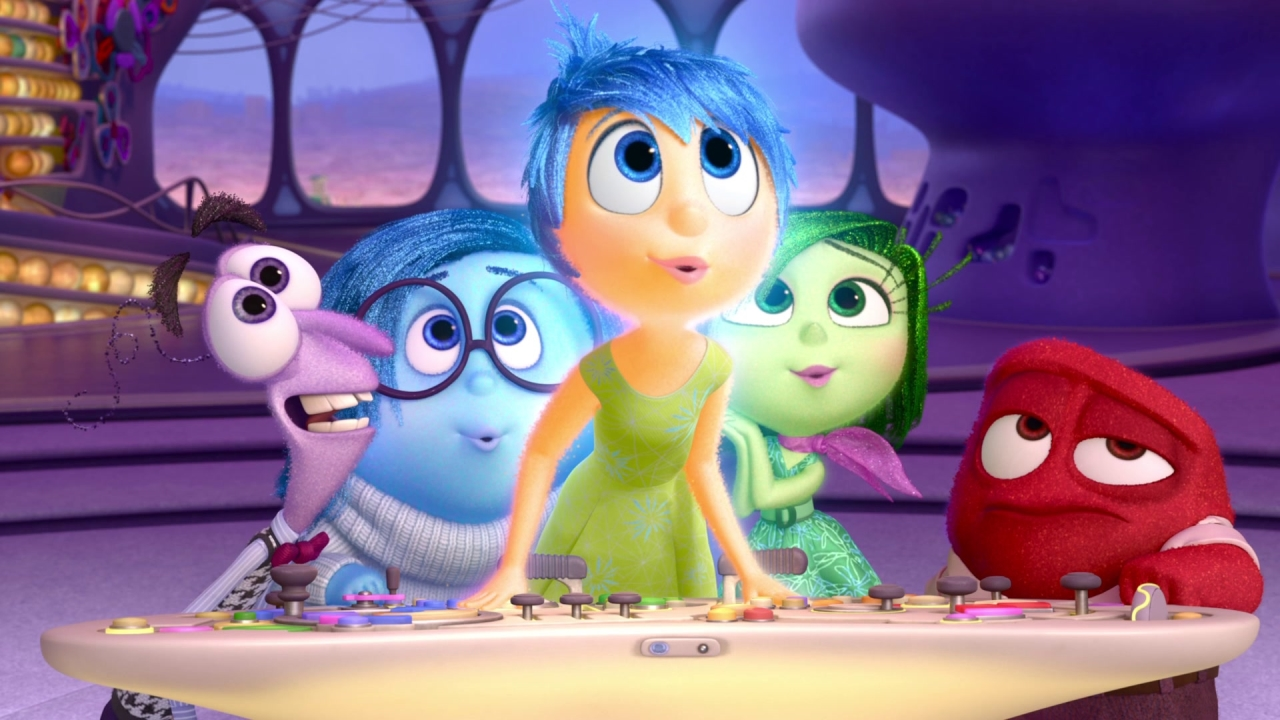
Homework
Writing tasks (each one page):
- Write about a time you felt your personality clashed with a friend or classmate.
- Imagine you created a new personality quiz for your school. Describe how you would design the test, and how you would try understand the results.
- Choose two different personality types and write a dialogue between them about working together on a project.
- Write about how you recharge your energy (quiet time, talking, doing tasks). Connect this to the idea of introversion/extroversion.
- Describe a hobby you do and think which MBTI preferences fit you when you’re doing it.
- Write a “letter to your future self” explaining how you hope your personality will grow and change over the next five years.
Debate Tasks:
- Should schools use personality tests to group students for projects?
- Side A (Yes): Because the tests help students work better by matching styles.
- Side B (No): Because the tests may label students unfairly and limit their growth.
- Key points for Side A: improved teamwork, awareness of differences, easier conflict resolution.
- Key points for Side B: fixed labels, unreliable tests, risk of bias and exclusion.
- Is it useful to talk about personality types in friendships?
- Side A (Useful): Because it helps friends understand each other and support each other.
- Side B (Not useful): Because it can simplify people too much and cause misunderstandings.
- Key points for Side A: empathy, improved communication, recognition of differences.
- Key points for Side B: reduces complexity, encourages stereotyping, overlooks change.
- Should adults rely on MBTI-style quizzes for choosing a career?
- Side A (Yes): Because the quizzes provide insight into strengths and preferences.
- Side B (No): Because the quizzes aren’t scientifically reliable and could mislead major life decisions.
- Key points for Side A: self-reflection, accessible language, career-awareness.
- Key points for Side B: lack of validity, changing personality, too simplistic.
Summary
People are wonderfully weird, but we still try to make sense of ourselves. MBTI hands us a simple set of letters and says: “This might be you.” And that’s both its charm and its challenge. It’s great at getting us to talk — about how we recharge, how we decide, how we live in the world. But it falters when it claims those letters hold the full story.
If you take a quiz and get four letters, treat them as a friendly nudge, not a verdict. The real action comes when you reflect, grow, and change — because life will keep nudging you then. And finally, remember this: the greatest “type” of all is the person who thinks, questions, and keeps learning.
Answer the following questions in full sentences. If you don’t know the right answer, do try write something, but add a (?) mark, and later we can look at it together.
1] What does it mean to have a “preference” in MBTI terms?
2] Why might the MBTI test give different results for the same person at different times?
3] How could knowing about personality differences help a group project in school?
4] Name one criticism of the MBTI’s scientific reliability.
5] Why is it helpful to treat personality labels as flexible rather than fixed?
6] What is the “flattery effect” and how might it influence how someone feels about their test result?
7] How might culture or experience change the way someone acts, even if they have the same MBTI type as another person?
8] What is one danger of believing your personality type can’t change?
9] Describe how a teacher might use MBTI knowledge to help students — but also what they should avoid.
10] In what way is personality like a spectrum rather than two boxes?
11] Why do people keep taking personality tests even if some scientists say they’re not very accurate?
12] How could a personality test be used wrongly in a job or hiring situation?
13] What’s the difference between reliability and validity in the context of tests like MBTI?
14] Give an example of a time you noticed you behaved differently in two situations — how might that show personality isn’t fixed?
15] Why is it useful to treat personality descriptions as starting points, not full descriptions?
16] What would you want your “ideal self” to be like in five years, and how might knowing your personality help you get there?
17] How can joking about your MBTI type be more helpful than taking it too seriously?
18] What does it mean if someone says “I’m just an INFP, I can’t focus,” and why might that be problematic?
19] Why is variety in personalities (having many different types in one group) valuable for society?
20] How can you use the idea of personality differences to make a friendship stronger?
One alternative test to be aware of, is the so called “Big Five” Personality Test.


 The Electronics Deli