Earth is constantly collecting dust from space. Most pieces are smaller than a grain of sand, so their arrival causes no dramatic crater, loud explosion, or worried dinosaur. During their fall through the atmosphere, some particles become hot enough to melt and form tiny spheres. Scientists find these particles in Antarctic ice, deep-sea sediment, desert soil, and even rooftop dust. The difficulty is proving that a small metal sphere came from space rather than from a factory, vehicle, firework, or careless angle grinder.
In the News
Building blocks of life found in samples from asteroid Bennu — Reuters, 29 January 2025. Scientists reported amino acids and all five nucleobases used by life in carefully protected asteroid material. The uncontaminated sample shows why clean collection matters when researchers study small extraterrestrial particles.
Astronomers trace the origin of meteorites that have struck Earth — Reuters, 17 October 2024. Researchers connected about 70% of known meteorites to three asteroid families by comparing compositions and modelling their orbits. Similar comparisons help scientists investigate the parent bodies of smaller particles.
‘It’s open!’: Nasa finally unlocks canister of dust from 4.6bn-year-old asteroid — The Guardian, 21 January 2024. Engineers made special non-magnetic tools to open the Bennu sample container without adding Earth material. Their precautions demonstrate the importance of contamination control in extraterrestrial-dust research.
What do you think?
1] Why do small falling objects usually cause less damage than large ones?
2] What might happen to a grain of rock moving through air at extremely high speed?
3] Why can a melted droplet become round while it is falling?
4] Where does dust collect around your school or home?
5] Why might an old, undisturbed surface preserve a better record than a busy road?
6] If a magnet attracts a black grain, what can you conclude, and what can you not conclude?
7] Why can two objects with the same shape have different origins?
8] What human activities produce hot sparks or tiny pieces of metal?
9] Why should a scientist record the exact place and date of a sample?
10] What could an empty collection container reveal about an experiment?
11] Why might snow and ice make dark particles easier to find?
12] What problems would salt water cause for a small metal-rich grain?
13] Why can a dry desert preserve old objects well?
14] What might make a city rooftop useful despite heavy pollution?
15] Why is a photograph through a microscope stronger evidence than a verbal description?
16] How could samples from a rooftop and a roadside be compared fairly?
17] Why should repeated results be trusted more than one exciting result?
18] What evidence would make you reject a shiny sphere as ordinary pollution?
19] If a meteor shower is visible, should you expect a bucket to fill with space grains that night? Explain your prediction.
20] When is it responsible to label a specimen “unknown” instead of giving it an exciting name?
Did You Know?
- Tens of thousands of tonnes of dust-sized extraterrestrial material may enter the atmosphere each year, but estimates vary because the smallest particles are difficult to measure.
- Micrometeorites are commonly about 50 μm to 2 mm wide; many can sit on a pencil point.
- In 1876, scientists from the HMS Challenger expedition described magnetic cosmic spherules from deep-ocean sediment.
- Rooftop dust may mix possible space particles with brake dust, welding droplets, industrial ash, rust, paint, soil, fibres, insects, and bird droppings. Space science sometimes begins in material that sensible people avoid touching.
Vocabulary
- atmospheric entry — 대기권 진입
- asteroid family — 소행성군
- background sample — 배경 시료
- brake dust — 브레이크 마모 먼지
- chemical composition — 화학 조성
- clean container — 깨끗한 용기
- collection area — 채집 면적
- contamination control — 오염 통제
- control sample — 대조 시료
- cosmic spherule — 우주 기원 구상 입자
- deep-sea sediment — 심해 퇴적물
- extraterrestrial material — 지구 밖 기원 물질
- false positive — 거짓 양성
- fusion crust — 용융각
- industrial ash — 산업 재
- magnetic separation — 자기 분리
- mineral grain — 광물 알갱이
- non-magnetic tool — 비자성 도구
- optical microscope — 광학 현미경
- parent body — 모천체
- particle size — 입자 크기
- polished section — 연마 단면
- repeated trial — 반복 실험
- sample label — 시료 표지
- scanning electron microscope — 주사 전자 현미경
- sieve mesh — 체의 그물눈
- terrestrial particle — 지구 기원 입자
- weathering — 풍화
- windblown dust — 바람에 날린 먼지
- written record — 기록문
Glossary
Micrometeorite — A very small natural particle from space that reaches Earth’s surface. It is usually between about 50 μm and 2 mm wide. It may remain unmelted, melt partly, or become a sphere during entry. 미소운석.
Meteoroid — A natural piece of rock or metal moving through space. It is smaller than an asteroid. If it enters an atmosphere, it may produce a meteor. 유성체.
Meteor — The streak of light produced when a fast space particle heats the surrounding atmosphere and loses material. It is an event, not the rock found on the ground. 유성.
Meteorite — A natural extraterrestrial object that survives atmospheric passage and reaches the ground. Most named meteorites are much larger than dust grains. 운석.
Ablation — The removal of material from a fast particle through heating, melting, and evaporation during atmospheric entry. Ablation can change both size and composition. 삭마.
Silicate — A mineral built mainly from silicon, oxygen, and other elements. Silicates form much of Earth’s crust and many rocky space objects. 규산염.
Magnetite — A strongly magnetic iron oxide mineral. It can form in melted extraterrestrial particles, but it is also common in terrestrial rocks and pollution. 자철석.
Wüstite — An iron oxide that can form under hot, oxygen-poor conditions. It may occur in cosmic spherules and industrial particles, so it is useful evidence but not final proof. 뷔스타이트(산화철 광물).
Isotope — One form of an element with a particular number of neutrons. Some isotope patterns can reveal exposure to cosmic rays or material from outside Earth. 동위원소.
Contamination — Unwanted material introduced before, during, or after collection. It can produce a false result if it resembles or changes the intended sample. 오염.
Dust from Space and a Fiery Arrival
Most micrometeorites begin as fragments released when asteroids collide or comets shed dust. Their parent bodies formed early in the Solar System, about 4.6 billion years ago. Gravity and sunlight slowly alter the grains’ paths until some meet Earth. A typical collected grain measures roughly 50 μm to 2 mm, although scientists use slightly different size limits. The smallest particles slow high in the atmosphere and may remain cool enough to preserve delicate material. Larger grains experience stronger heating. Their small size makes them abundant but difficult to separate from the much greater quantity of ordinary terrestrial particle pollution.
1] What are two major sources of the grains before they reach Earth?
2] Why can the smallest grains preserve delicate material?
A particle approaching Earth travels at least about 11 km/s before air resistance slows it. It compresses and heats the air in front of it, while collisions remove energy from its motion. Heating may melt the surface or the whole grain for only a few seconds. Ablation removes material by melting and evaporation. A fully molten droplet is pulled into a rounded form by surface tension and then cools into a cosmic spherule. Not every grain becomes spherical. Entry speed, angle, size, composition, and rotation all affect the final shape, which is why roundness alone cannot prove an extraterrestrial origin.
1] What processes remove material from a grain during entry?
2] Why do some incoming particles remain irregular rather than becoming spheres?
Researchers classify recovered particles by how much melting they experienced and what they contain. Unmelted grains may preserve fine minerals and carbon-rich matter but are especially hard to recognize among Earth dust. Partly melted particles show both original and altered regions. Completely melted silicate droplets can develop barred olivine crystals, radiating crystals, or very fine cryptocrystalline textures as they cool. Metal-rich particles may contain iron oxides such as magnetite and wüstite. However, furnaces and welding can create similar spheres. A useful identification therefore combines texture, mineral relationships, chemical composition, and collection context instead of relying upon one attractive feature.
1] What information can a partly melted particle preserve?
2] Why is the presence of magnetite insufficient for identification?
After cooling, a particle falls through the lower atmosphere and enters soil, snow, water, or a constructed surface. Water and oxygen can cause weathering, especially in iron-rich grains. Flowing water may move particles into gutters, cracks, lakes, and ocean basins. Wind can concentrate grains by size and density, but it also adds local mineral dust. Scientists estimate that several thousand to tens of thousands of tonnes of extraterrestrial dust reach Earth each year; the exact value depends on size and measurement method. This global fall means collection is possible almost anywhere, yet local contamination decides whether the evidence will be clear or muddled.
1] Which environmental processes move or alter particles after landing?
2] Why does a worldwide supply not make every collection site equally useful?
What Tiny Grains Reveal About the Solar System
One early scientific clue came from the HMS Challenger expedition of 1872–1876. Researchers examining slowly formed deep-sea sediment reported small magnetic spheres and suggested that some came from space. Later collections from polar snow, ice, and ocean sediments produced far larger sets. These environments accumulate particles over known areas and can preserve layers from different times. Modern researchers also recover micrometeorites from sedimentary rocks hundreds of millions of years old. A grain is therefore both a space sample and a time marker. Its value increases when scientists know its exact layer, location, collection method, and relation to nearby material.
1] Why were deep-sea sediments useful in early studies?
2] What information is lost when a grain’s original layer is not recorded?
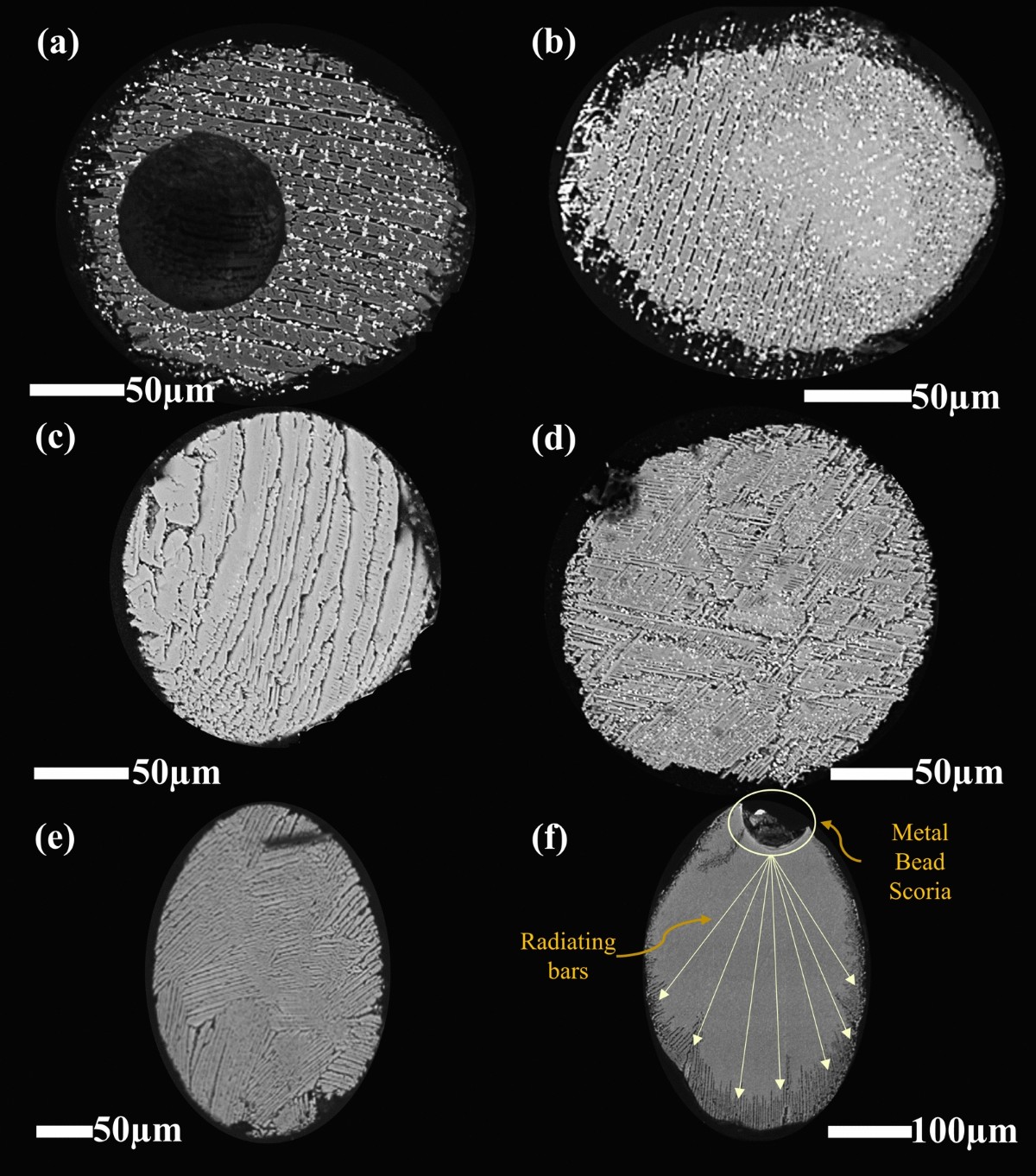
Minerals and textures record the short heating event during atmospheric entry. Under a microscope, barred olivine may appear as parallel crystal strips inside a silicate sphere. Magnetite can form a shell or tiny crystals where hot iron reacts with oxygen. Vesicles are bubbles left when gas escaped from molten material. Industrial ash can also have bubbles, iron oxides, and round shapes, so researchers inspect combinations rather than isolated signs. A polished section reveals the interior, while reflected light shows metal and crystal patterns. Comparing many confirmed specimens builds a reference collection against which an unknown grain can be tested.
1] What does a polished section reveal that an outside view may hide?
2] Why do researchers compare several features at once?
Chemical evidence is stronger than colour or magnetism. A scanning electron microscope can image a surface at high magnification. An attached energy-dispersive X-ray system estimates which elements occur in a tiny point or region. Many stony micrometeorites show relationships among magnesium, silicon, iron, nickel, and other elements that resemble primitive meteorites. Some industrial spheres contain unusual amounts of chromium, manganese, titanium, or manufactured alloys. Even chemical similarity is not always final proof, because Earth minerals vary. Rare measurements of oxygen isotopes, cosmogenic isotopes, or solar-wind gases can provide much stronger evidence, but these tests require specialist laboratories.
1] What two jobs can electron-microscope equipment perform on a specimen?
2] Why can an elemental match still leave some uncertainty?
Collections reveal changes in the supply of material reaching Earth. Fossil micrometeorites in roughly 470-million-year-old rocks preserve evidence of a major asteroid breakup that also produced many L-chondrite meteorites. Modern grains include material linked to asteroids and probably many comets. Carbon-rich particles may preserve organic compounds, although heating and weathering can alter them. Scientists compare particle types in dated layers to investigate ancient collisions, atmospheric oxygen, and entry conditions. Interpretation remains cautious: a collection can be biased by magnets, sieve mesh, chemical weathering, or human choices. What researchers fail to collect can influence a conclusion as strongly as what they find.
1] What ancient event can fossil grains help researchers investigate?
2] How can collection equipment bias the types of particles recovered?
Finding Micrometeorites Around the World
Antarctica provides some of the cleanest collection areas. Dark particles stand out on snow, and old ice can concentrate material where ice melts or is eroded. Researchers have filtered large volumes of clean snow and water near remote stations, including collections around Dome C and the South Pole. Low human activity reduces industrial ash, although research stations, aircraft, and machinery still create contamination. Polar work also requires permits, trained teams, sterile equipment, and careful environmental protection. Antarctica is scientifically excellent but unsuitable for a casual school trip; the permission forms may outweigh the students before the winter clothing does.
1] Why are Antarctic snow and ice useful collection surfaces?
2] What local sources can still contaminate a remote polar sample?
Deep-sea sediment receives particles over broad areas and often accumulates slowly. Ocean expeditions can collect cores or scrape selected deposits, and dense magnetic grains may become concentrated in certain layers. The method helped establish the study of cosmic spherules, but it has serious complications. Volcanic material, ship emissions, industrial particles, and erosion products also reach the sea. Salt water changes some minerals, while currents mix particles of different ages. Collection is expensive, and the exact path of one tiny grain is usually unknown. Deep-ocean sites are valuable scientific archives, not simple proof that every recovered black sphere came from space.
1] What makes deep-sea sediment a useful long-term archive?
2] Which processes can mix or alter particles there?
Hot deserts such as the Atacama in Chile and parts of the Sahara preserve meteorite material because rainfall and vegetation are limited. Stable surfaces can hold old particles for long periods, and dark grains may be visible against pale sediment. However, windblown dust includes terrestrial magnetite, volcanic grains, and industrial material transported from distant areas. Desert varnish and weathering can also change surfaces. A carefully mapped, remote desert site is better than sand beside a mine or road. Collectors must follow national laws, land-access rules, and scientific permit requirements; removing material without permission can damage research and cultural heritage.
1] Why can a dry desert preserve extraterrestrial material for a long time?
2] What legal and scientific checks are necessary before collection?
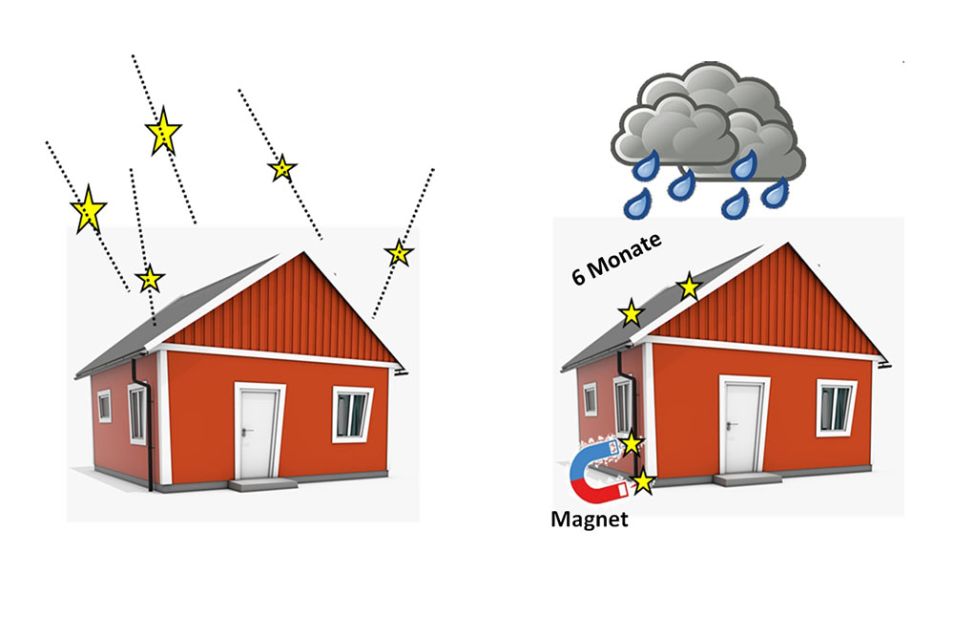
Flat roofs and gutters in many cities act as large dust traps. Studies have confirmed modern micrometeorites in urban collections, especially from roofs with known construction dates and large drainage areas. Rooftops are accessible and can provide recent material, but they are among the hardest places for reliable identification. Brake dust, railways, welding, fireworks, furnaces, roof corrosion, and construction all make magnetic or spherical particles. A roof far from heavy industry and recently installed metalwork is preferable. Samples should never be described as confirmed micrometeorites from appearance alone; “candidate” is the accurate label until several tests agree.
1] What information about a roof improves the scientific value of its dust?
2] Why should a visually promising urban grain first be called a candidate?
A Reliable Search: Collection, Tests, and False Positives
A useful school experiment compares contamination rather than promising a space discovery. Choose two safe sites, such as a large flat roof and a ground-level area near a road, with permission. Mark equal collection areas or use containers with equal openings for the same number of dry days. Wear gloves and use separate clean containers, brushes, and non-magnetic tools. Label every sample with date, area, weather, and nearby pollution sources. Keep one unopened clean container as a control sample. If it later contains particles, the handling method introduced contamination. Never climb onto a roof without authorized adult access and proper safety controls.
1] Why should the two collection sites use equal areas or equal container openings?
2] What can the unopened control container reveal?
Dry each sample in a covered container, then pass it through a series of clean sieve mesh sizes, perhaps keeping the 100–500 μm fraction for inspection. Wrap a strong magnet in a clean plastic bag and move it beneath or above the sample; remove the bag carefully to release attracted grains. This magnetic separation reduces the amount of material, but it rejects many weakly magnetic silicate grains and strongly favours iron pollution. Record the starting mass, retained size fraction, and number of candidates at every stage. Repeat the trial. A method that produces records and repeatable comparisons is more valuable than a jar labelled “space dust.”
1] What important specimens might magnetic separation fail to collect?
2] Which records allow another group to repeat the method?
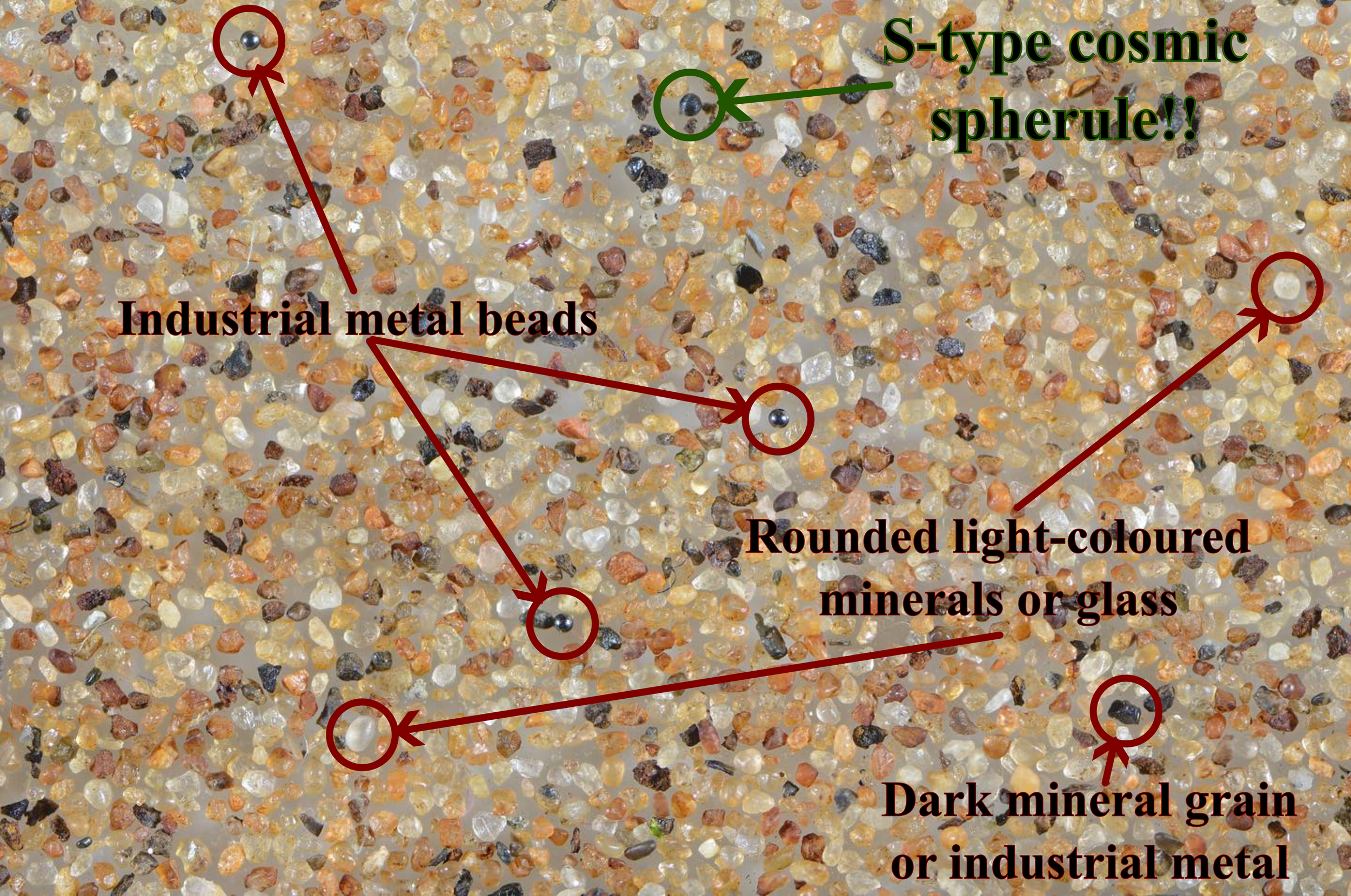
Place candidate grains on clean card and examine them with an optical microscope at several magnifications. Photograph both sides beside a scale. Look for a smooth sphere, a glassy or stony surface, a thin fusion crust, or organised crystals, but treat each as supporting evidence only. Reject obvious wire pieces, flat flakes, sharp machining fragments, painted grains, and clusters of fused spheres. Compare roof candidates with roadside and workshop background samples. If the same types are much more common beside brakes or grinding equipment, pollution is the simpler explanation. Do not cut, heat, or use acids on school samples; these actions can destroy evidence or create hazards.
1] Which visible features suggest that a specimen is manufactured debris?
2] How does a background sample help test a candidate’s origin?
Reliable confirmation normally requires a scanning electron microscope, interior images of a polished section, and chemical composition measured in a qualified laboratory. A convincing result matches several known extraterrestrial textures and element relationships while excluding local industrial sources. The strongest natural archives are remote Antarctic snow or ice, carefully chosen deep-sea sediment, and old stable desert surfaces. Remote clean-snow regions of Greenland can also be useful under controlled research conditions. Urban roofs are practical for experiments but have the highest false-positive risk. Keep uncertain grains, records, and images; “unidentified” is a sound scientific result, whereas a confident mistake is merely pollution wearing a space helmet.
1] What combination of evidence is normally needed for reliable confirmation?
2] How do clean polar sites and urban roofs differ as collection locations?
Homework
1] Write approximately one page explaining why a round, magnetic grain is not automatically from space. Address shape, magnetism, pollution sources, and the evidence needed for confirmation.
2] Write approximately one page comparing an Antarctic collection site with an urban rooftop. Address access, contamination, preservation, safety, and scientific reliability.
3] Write approximately one page explaining what happens to a small rocky grain during atmospheric entry. Address speed, air heating, melting, ablation, and cooling.
4] Write approximately one page arguing whether a school should conduct a rooftop-particle investigation. Address learning value, safety, equipment, and limits on any conclusions.
5] Write approximately one page designing a fair comparison between rooftop dust and roadside dust. Address equal sampling, labels, controls, repeated trials, and expected contamination.
6] Write approximately one page explaining why “unidentified” can be a responsible scientific conclusion. Address uncertainty, false positives, missing tests, and honest reporting.
7] Write approximately one page describing how location changes the quality of a sample. Compare snow, ocean sediment, desert surfaces, and city roofs.
8] Write approximately one page explaining how microscopes and chemical instruments provide different kinds of evidence. Address surface form, interior texture, elements, and limitations.
9] Write approximately one page arguing for or against using a magnet as the first separation tool. Address speed, bias, missed grains, and iron-rich pollution.
10] Write approximately one page explaining why a written record is part of the scientific sample. Address date, place, collection area, conditions, and later verification.
1] Should schools describe promising grains as micrometeorites before laboratory confirmation?
Side A — Yes, because: 1) a carefully stated preliminary label can motivate investigation; 2) strong visual evidence may justify a working classification; 3) students can revise the label when new evidence appears.
Side B — No, because: 1) visual evidence produces many false positives; 2) exciting labels may be repeated as facts; 3) “candidate” reports uncertainty more accurately.
2] Should researchers prioritize remote collection sites over accessible urban sites?
Side A — Yes, because: 1) remote sites usually have less industrial contamination; 2) cleaner samples improve reliability; 3) dated ice or sediment may preserve useful history.
Side B — No, because: 1) urban sites are cheaper and easier to repeat; 2) wide public participation can produce large datasets; 3) laboratory tests can sometimes overcome contamination.
3] Should a school use magnetic separation when it creates a known sampling bias?
Side A — Yes, because: 1) it makes a large sample manageable; 2) it is inexpensive; 3) the bias can be measured and reported.
Side B — No, because: 1) it misses weakly magnetic grains; 2) it concentrates industrial iron; 3) students may mistake convenience for complete evidence.
Answer the following questions in full sentences. If you don’t know the right answer, add a (?) mark, and later we can look at it together.
1] What is a micrometeorite?
2] Where do most micrometeorites begin their journey?
3] Why does atmospheric entry heat an incoming particle?
4] What is ablation?
5] Why can a molten particle become spherical?
6] Why do some grains survive without melting completely?
7] What can barred olivine reveal about a particle?
8] Why is magnetite not proof of an extraterrestrial origin?
9] What did the HMS Challenger expedition contribute to this field?
10] How can chemical composition help identify a specimen?
11] What special evidence can isotopes provide?
12] How can a collection method bias a scientific conclusion?
13] Why is Antarctica a strong collection region?
14] What are two difficulties with deep-sea samples?
15] Why do dry deserts preserve particles well?
16] Why do urban rooftops produce many false positives?
17] What information belongs on a sample label and written record?
18] What is the purpose of a control sample?
19] Why should students compare candidates with background samples?
20] What evidence is normally required to confirm a candidate reliably?
Teaching illustrations and similes
1] Atmospheric entry — Compare it to a cyclist feeling stronger air resistance at higher speed, but note that entry speeds and heating are enormously greater.
2] Surface tension — A molten grain rounds like a small water droplet, but molten rock is much hotter and more viscous than water.
3] Ablation — It resembles a bar of soap losing material as it is used, but atmospheric ablation is caused mainly by intense heating and evaporation.
4] Layered sediment — It acts like a history book whose pages arrive one above another, but currents and animals can mix some “pages.”
5] Magnetic separation — It is like selecting only students wearing black shoes; it is quick but misses every suitable student wearing another colour.
6] Control sample — It is an unopened spare plate at a picnic: if crumbs appear on it, the handling or surroundings added them.
7] Multiple evidence — Identification resembles a court case in which shape, texture, chemistry, and context must agree; no single witness is perfect.
8] False positive — Industrial slag can wear the same visual “uniform” as a cosmic spherule, so appearance does not establish identity.
9] Reference collection — It works like a reliable field guide, but natural specimens vary and may not match one example exactly.
10] Scientific uncertainty — Calling a grain “unidentified” is like leaving a puzzle piece aside until more of the picture exists; it does not mean the investigation failed.
Picture options
A]
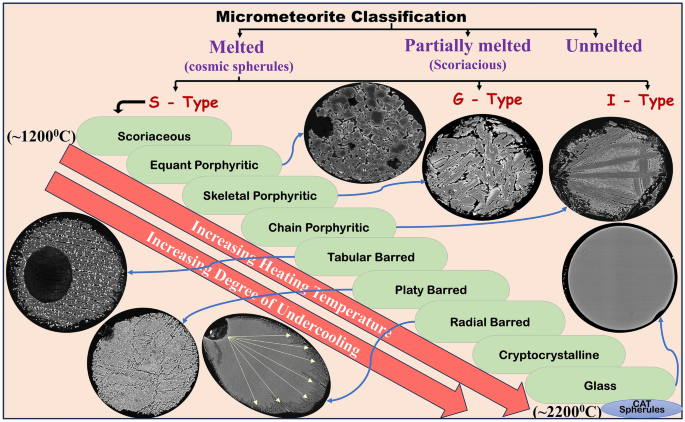
Source: Progress in Earth and Planetary Science. This diagram explains how increasing entry heating produces unmelted, partly melted, and fully melted particle types. Proposed insertion: “Dust from Space and a Fiery Arrival,” after the paragraph beginning “Researchers classify recovered particles.”
B]
Source: Progress in Earth and Planetary Science. These images explain the internal crystal patterns used when classifying melted silicate particles. Proposed insertion: “What Tiny Grains Reveal About the Solar System,” after the paragraph beginning “Minerals and textures record.”
C]
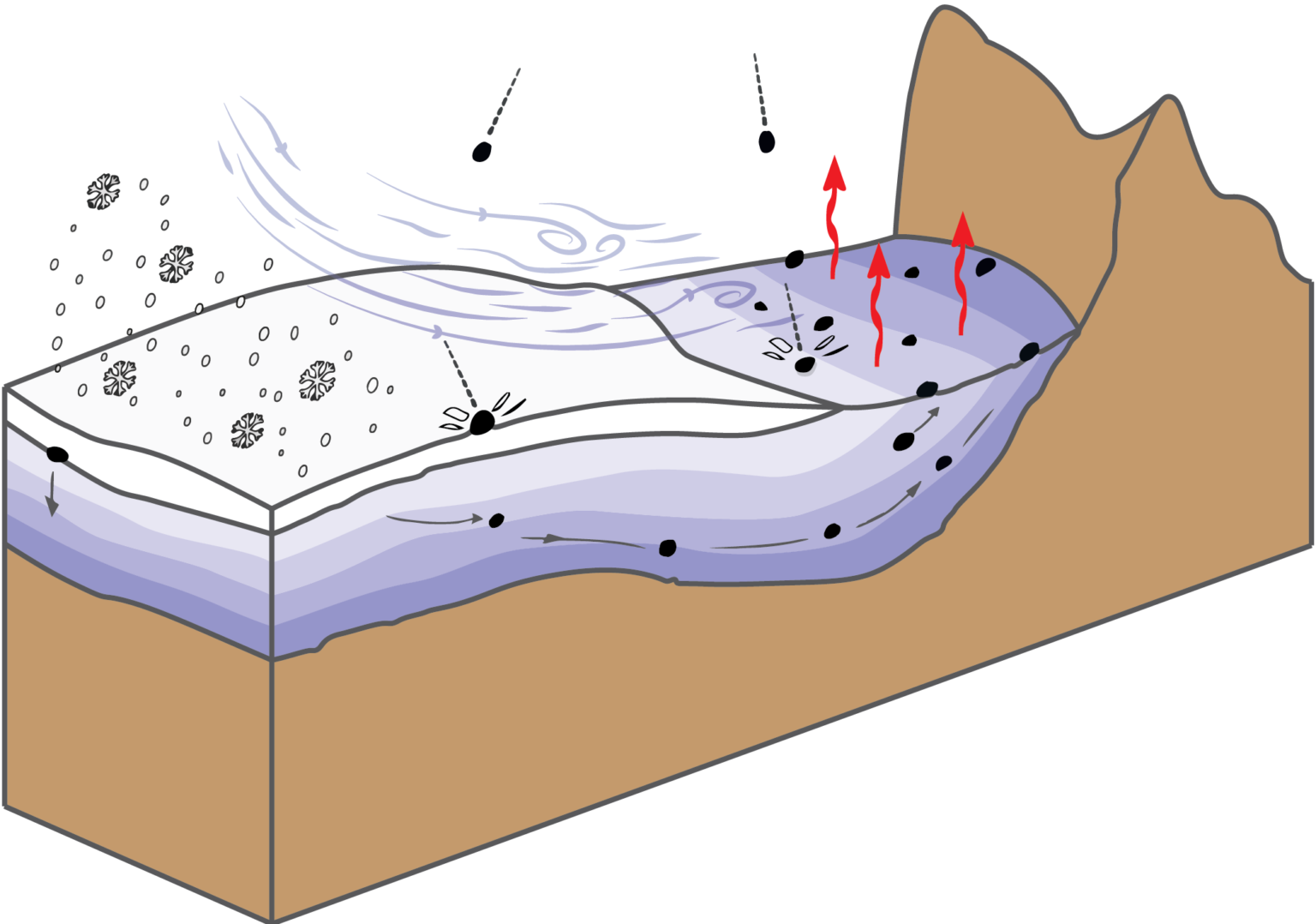
Source: European Geosciences Union. This diagram explains how moving ice and surface ice loss concentrate extraterrestrial material in Antarctic blue-ice areas. Proposed insertion: “Finding Micrometeorites Around the World,” after the paragraph beginning “Antarctica provides.”
D]
Source: Heinz Maier-Leibnitz Zentrum and Technical University of Munich. This diagram explains a simple rooftop collection sequence and its dependence on later laboratory analysis. Proposed insertion: “A Reliable Search: Collection, Tests, and False Positives,” after the paragraph beginning “Dry each sample.”
E]
Source: Cosmic Spherules educational project, with research guidance from the Imperial College London Micrometeorite Group. This comparison explains why colour, roundness, and magnetism create false positives. Proposed insertion: “A Reliable Search: Collection, Tests, and False Positives,” after the paragraph beginning “Place candidate grains.”
F]
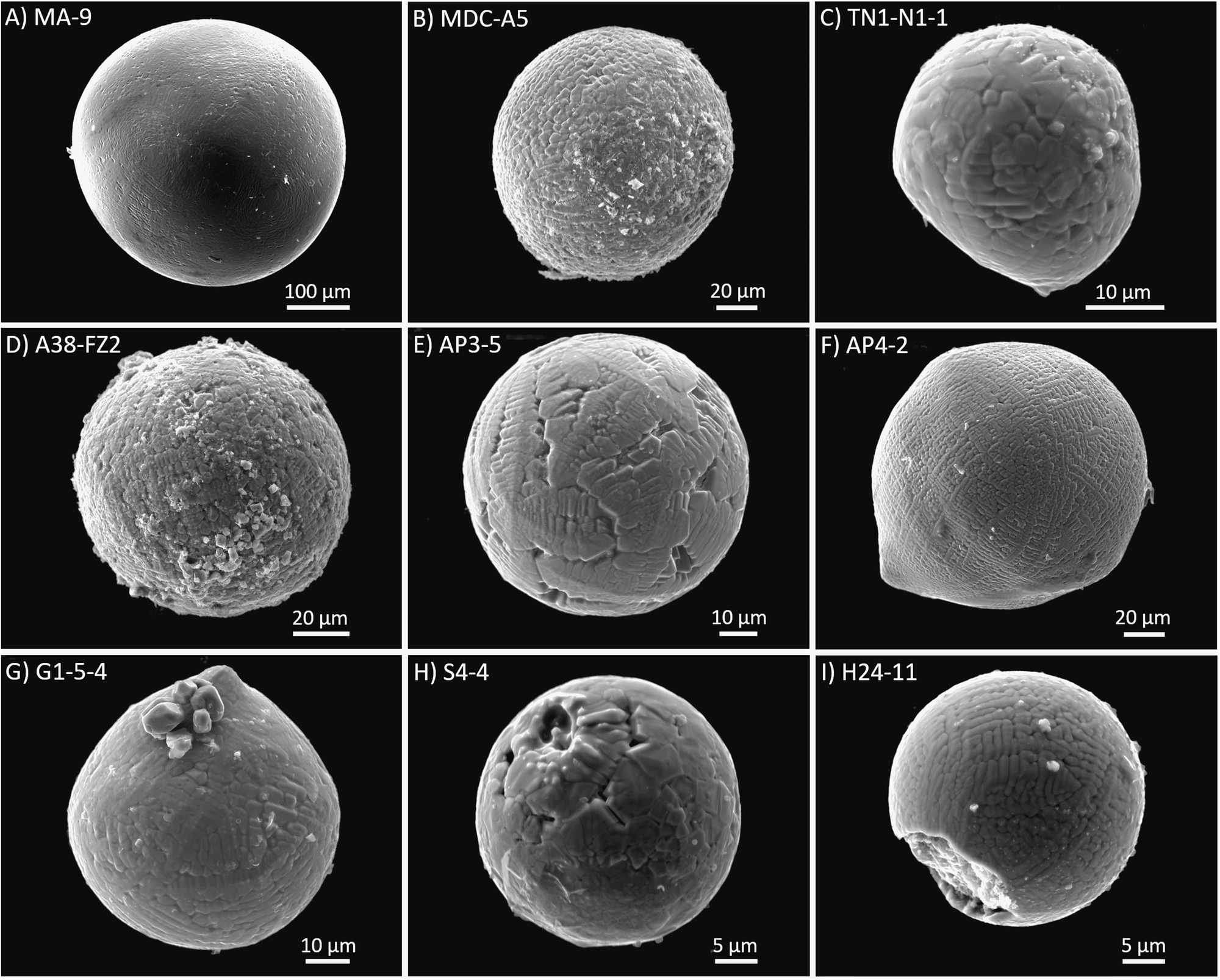
Source: Communications Earth & Environment. These images explain the real surface variation of confirmed iron-rich cosmic spherules and the importance of scale bars. Proposed insertion: “What Tiny Grains Reveal About the Solar System,” after the paragraph beginning “Chemical evidence is stronger.”
G]
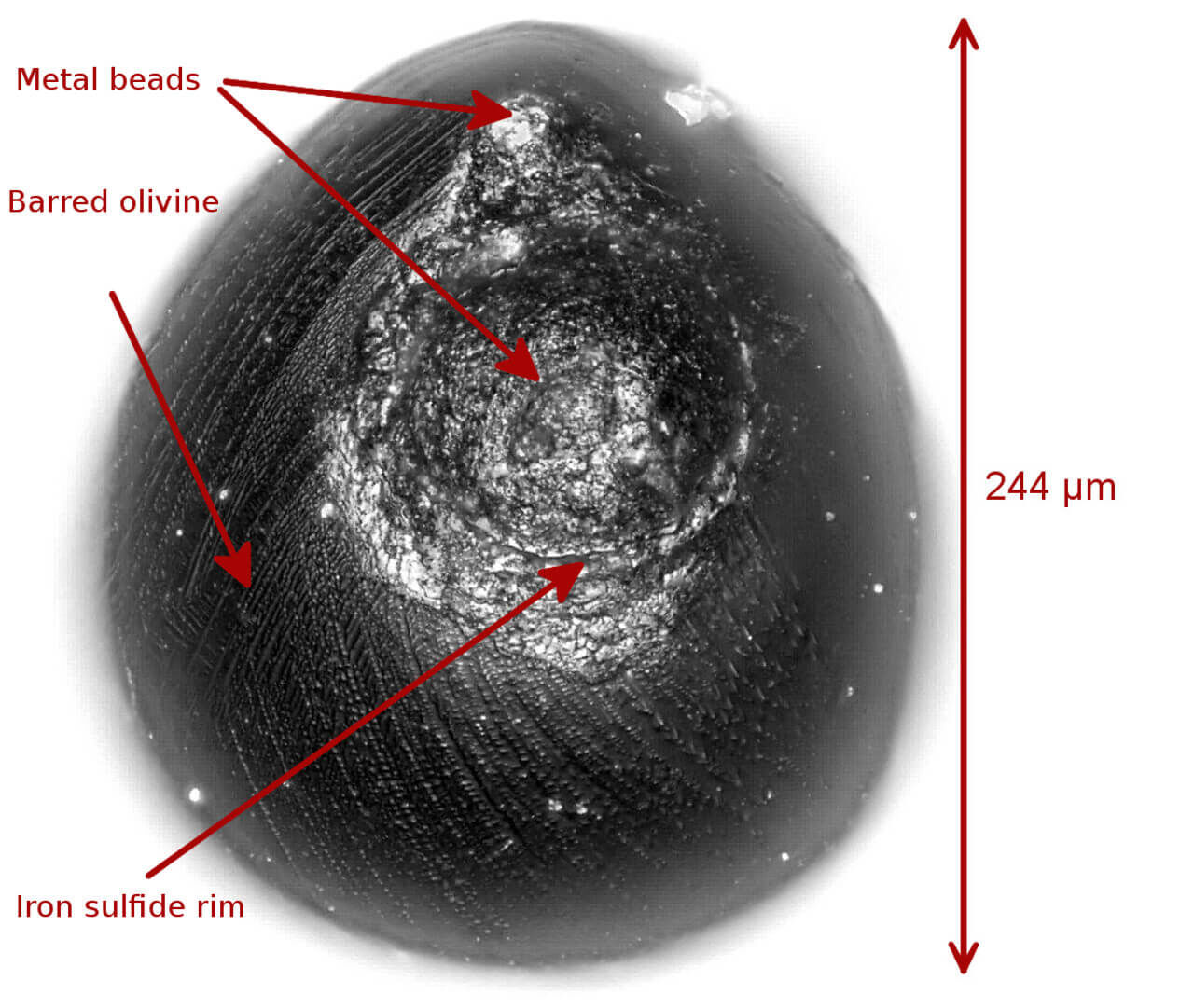
Source: AstroGC educational micrometeorite collection. This image explains visible barred-olivine texture in a 244 μm rooftop specimen. Proposed insertion: “A Reliable Search: Collection, Tests, and False Positives,” after the paragraph beginning “Place candidate grains.”
Choose which picture options to include or discard. You may also request replacement options.