Much of the fuel moving a car began with organisms too small to admire without a microscope. After burial, heat, and an extremely long wait, some of their remains became oil. Nobody arranged this useful service for modern drivers. Geology happened first, and humans arrived much later with drills and ambitious plans. Around the Persian Gulf, large oil deposits helped change towns, governments, and international relationships. The earlier shipping lesson followed manufactured goods inside boxes. Here the cargo is a liquid, and its journey begins inside rock rather than inside a factory.
In the News
Resilient Saudi economy proves a draw for wartime Gulf business — Reuters, 3 June 2026. The report described domestic business activity and efforts to develop industries beyond oil. It showed how transport options and a broader economy can help a country withstand disruption.
Saudi Arabia unexpectedly cuts November oil prices to Asia to 6-year lows — Reuters, 4 October 2026. The report, updated on 5 October, linked discounts to unusually expensive tanker transport. A country’s income depends partly on the cost of getting its oil to customers.
Mideast war escalation threatens recovery in global oil refining — Reuters, 22 July 2026. Conflict disrupted crude supplies needed by refineries. Producing usable fuels requires a working chain of extraction, delivery, and processing.
What do you think?
1] Why are some valuable materials hidden underground?
2] What can happen to dead plants buried in mud?
3] Why might drilling in the wrong place waste money?
4] Why does a sponge hold water while a glass marble does not?
5] What makes a liquid difficult to carry in an open basket?
6] Why might an underground pipe be useful?
7] Why do people clean or separate materials before using them?
8] What might change when a town suddenly earns more money?
9] Why is having only one source of income risky?
10] What makes a job useful beyond its immediate wages?
11] Why might a seller want several customers?
12] How could a fuel shortage affect a farm?
13] Why does making something valuable not guarantee a buyer?
14] What makes clean water especially important in a dry place?
15] Why might two nearby countries have different levels of wealth?
16] What responsibilities come with a sudden financial gain?
17] Why can a leaking liquid cause problems beyond its container?
18] How might people prepare for a resource becoming less useful?
19] Why should a government save money during good years?
20] How could events far away affect the price of a bus journey?
Did You Know?
1] Bahrain’s first major oil discovery was in 1932; commercial production at Saudi Arabia’s Dammam No. 7 began in 1938.
2] Most crude oil began with buried organic material, often including tiny marine organisms; it is not mainly a collection of melted dinosaurs.
3] An oil barrel is a measurement of approximately 159 litres, even when the oil never enters a physical barrel.
4] Underground oil usually occupies tiny spaces within rock rather than a giant empty cave.
Vocabulary
- buried — 묻힌
- remains — 남은 흔적
- mud — 진흙
- heat — 열
- pressure — 압력
- layer — 층
- trapped — 갇힌
- drill — 뚫다
- sample — 표본
- leak — 누출
- pipe — 관
- pump — 펌프
- storage — 저장
- flammable — 불이 잘 붙는
- spill — 유출
- income — 소득
- public services — 공공 서비스
- road — 도로
- hospital — 병원
- education — 교육
- skilled worker — 숙련 노동자
- ownership — 소유권
- contract — 계약
- negotiate — 협상하다
- demand — 수요
- saving — 저축
- investment — 투자
- pollution — 오염
- alternative — 대안
- renewable — 재생 가능한
Glossary
Crude oil — This liquid mixture comes from underground deposits. It contains many different carbon-based substances. It usually needs processing before use as transport fuel. 원유.
Fossil fuel — This fuel formed from ancient organic material. Oil, coal, and natural gas are examples. They take so long to form that people cannot replace them at the rate they use them. 화석 연료.
Reservoir rock — Oil or gas occupies connected spaces in this rock. The rock can hold fluids and sometimes let them move. A reservoir is not usually an empty underground room. 석유나 가스를 머금은 암석.
Porosity — This describes the spaces within a material. A porous rock can contain fluids. Connected spaces also help fluids move through it. 공극률.
Oil field — This area contains underground oil deposits that can be developed. It may have several wells and supporting facilities. Its usefulness depends on access and production costs. 유전.
Refinery — This facility processes crude oil. It separates components and changes some into useful products. Fuel quality also requires cleaning and careful control. 정유 시설.
Distillation — Heating a mixture helps separate substances with different boiling behaviour. Vapours cool and return to liquid. Refineries use this process as one stage of oil processing. 증류.
Tanker — This ship carries large quantities of liquid in tanks. Oil tankers carry crude oil or petroleum products. Their equipment must control movement, leaks, and fire risks. 액체 화물 운반선.
Diversification — An economy develops several sources of income. It becomes less dependent on a single product or industry. New industries still need skills, investment, and customers. 경제 활동의 다각화.
Desalination — A process removes salt from seawater. The resulting water can be treated for human use. The process needs equipment and energy. 해수 담수화.
How Oil Forms
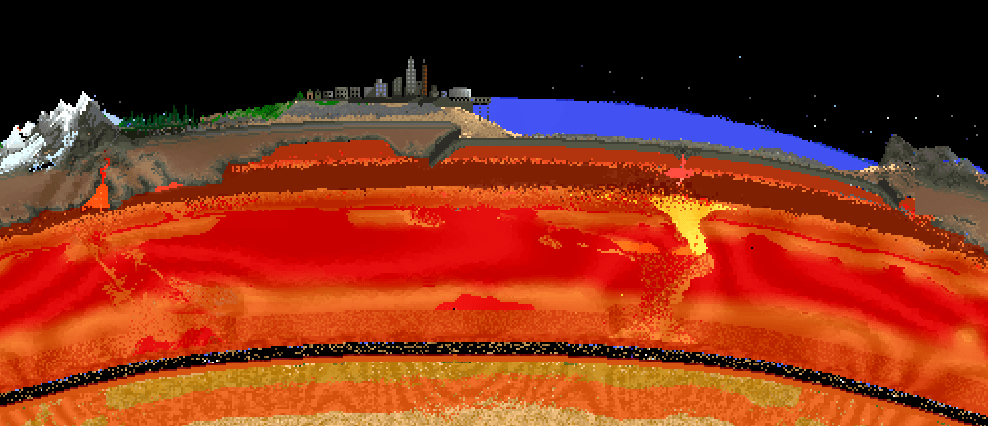
Oil formation begins with organic material, meaning material that once belonged to living things. Tiny marine organisms are an important source. When they died, some settled into mud where little oxygen reached them. This reduced the amount destroyed by decay. Later layers buried the material deeper. Over millions of years, heat changed it into substances that could form oil and gas. Pressure accompanied burial, but heating and the right geological conditions were essential. Most dead organisms never become useful oil deposits. A beach full of seaweed is therefore not a fuel station waiting politely for next summer.
1] Why did low-oxygen conditions help preserve some organic material?
2] Why does every pile of dead organisms not become an oil deposit?
Oil can move away from the rock where it formed. It may enter reservoir rock containing connected pores, or tiny spaces. These spaces hold liquid rather like the gaps in a sponge hold water, although rock is much harder. A layer that fluids cannot easily pass through can prevent further movement and keep the oil trapped. Without a suitable trap, oil may escape or remain too scattered to collect usefully. An oil field therefore depends on several conditions working together. The material must form, move into suitable rock, and stay concentrated. Finding only one of those conditions is not enough.
1] Where is oil held inside reservoir rock?
2] Why does a useful deposit need a trap?
Large parts of the Gulf region have a geological history involving ancient seas and thick layers of sediment. These conditions helped create and preserve major oil deposits. The dry landscape visible today does not describe everything that happened beneath it in the distant past. However, deposits are not spread evenly across the region. Different rock structures and histories produce different results. Geologists examine rock samples and use sound-based surveys to investigate underground layers. Their work guides drilling, but a promising survey cannot guarantee a profitable well. The ground does not provide a neatly labelled map of its contents.
1] Why can a dry modern landscape contain oil formed from marine material?
2] Why do geologists still need to test promising sites?
Oil is described as non-renewable because it forms far more slowly than people use it. A country can discover new deposits, but discovery does not create new oil. Not all oil underground can be extracted, and not every deposit is worth developing. Depth, rock conditions, technology, and prices influence the decision. Engineers also distinguish an estimate of total oil from the amount recoverable under stated conditions. Those figures can change when conditions change. This is why careful reports explain what their numbers mean. Saying there is oil underground is useful; saying how much can realistically be obtained is more useful.
1] Why does discovering a deposit not make oil renewable?
2] What conditions affect whether oil can be extracted economically?
From Oil Field to Tanker
An oil field contains wells and the equipment needed to bring fluids to the surface. Workers drill through underground layers and install protective pipe inside the well. Oil may initially rise because of pressure, while pumps or other methods help maintain production later. The fluids reaching the surface can include water and gas as well as crude oil. They need separation and treatment before further transport. A well is therefore one part of a larger system. It is not simply a straw placed into a convenient underground puddle. Controlling the flow helps protect workers, nearby land, and valuable equipment.
1] Why must fluids from a well be treated?
2] Why is a well only one part of an oil field’s working system?
Crude oil is a mixture, and a car engine cannot use every part of it as supplied. At a refinery, distillation separates groups of substances according to their boiling behaviour. Heating turns some components into vapour, which cools and collects at different stages. Further processing changes some substances and removes unwanted substances. The refinery can produce fuels such as petrol, diesel, and jet fuel, along with materials used by other industries. Different crude oils require different treatment. A refinery is closer to a carefully controlled industrial kitchen than a filter, although its products should never be served for lunch.
1] What does distillation help a refinery do?
2] Why does separating crude oil not complete every stage of refining?
Pipelines move oil between production areas, storage sites, refineries, and export terminals. Pumps maintain the flow, while valves help control sections of the system. A pipeline can carry large quantities without a separate vehicle accompanying every load. However, it follows a fixed route and requires maintenance. Corrosion, equipment failure, or an attack can interrupt it. Workers monitor for leaks because escaped oil can contaminate land and water. Building another route may improve reliability, but it requires permission, money, and time. A useful line on a map must become a safe physical structure before any oil moves through it.
1] What is one advantage of a pipeline?
2] Why is a second pipeline route not an instant solution?
Oil tankers connect exporters with customers across the sea. They carry liquid cargo in tanks, unlike the container ships discussed earlier. Loading equipment transfers oil through hoses or pipes, and crews monitor the process carefully. Oil can be flammable, while a spill can harm wildlife and coastal communities. Modern tankers often use double hulls, creating an extra protective space between the cargo and the sea. This reduces some risks without making accidents impossible. Producing oil is only the first commercial step. Without safe transport and an available customer, the producer may own a valuable resource but lack a dependable income.
1] How does a tanker’s cargo system differ from a container ship’s?
2] Why does having oil underground not guarantee dependable income?
Oil and Changing Societies
Before large-scale oil development, Gulf communities already had working economies and varied histories. Fishing, pearl diving, trade, agriculture in suitable places, and other activities supported livelihoods. It would be inaccurate to describe the region as an empty desert waiting for oil. Bahrain’s discovery in 1932 and commercial production at Saudi Arabia’s Dammam No. 7 in 1938 marked important changes. Production expanded at different times elsewhere. New export income could support roads, hospitals, schools, and electricity networks. The speed and scale of change depended on government decisions, population, and the amount of oil available, rather than geography alone.
1] Why is it misleading to say Gulf economies began with oil?
2] What factors influenced how oil income changed different countries?
Oil income gives governments choices about public services and investment. They may improve education, build transport systems, or save part of the revenue for later years. These decisions can improve living standards, but money alone does not guarantee good results. A hospital needs trained staff as well as a building. Education needs teachers and useful learning rather than a handsome sign at the entrance. Planning also matters when income changes. Projects started during expensive-oil years may become harder to fund when prices fall. A useful government budget considers the cost of maintaining services, not only the excitement of opening them.
1] Why does a new hospital need more than construction money?
2] How can changing oil prices affect public projects?
Growing cities need skilled workers in construction, medicine, engineering, transport, and many other fields. Gulf development attracted people from different countries, linking local economies with families abroad. Migrant workers can gain wages and experience, while employers obtain needed skills and labour. However, working conditions, legal protection, and fair treatment matter. The benefits of growth are not automatically shared equally. Citizenship, ownership, and access to services can also shape people’s opportunities. A wealthy national economy can contain workers facing serious hardship. Looking only at impressive buildings therefore misses an important question: who builds them, and under what conditions?
1] How can migration connect Gulf economies with other countries?
2] Why does national wealth not prove that every worker benefits equally?
Oil also changed political relationships. Early development often involved foreign companies through contracts giving them access to deposits. Governments later increased control over production in different ways. Ownership affected who received income and who made decisions. Exporters then negotiated with buyers who needed steady supplies. These relationships could produce cooperation, disagreements, or attempts to gain influence. International importance followed both the resource and the ability to deliver it. Countries importing oil had reasons to pay attention to the Gulf even when it lay far from their borders. Energy could connect places with little else in common.
1] Why does ownership of production matter?
2] Why do distant importing countries pay attention to the Gulf?
Wealth, Risks, and Choices
Oil prices respond to supply, demand, expectations, and other market conditions. If buyers need more than sellers can readily provide, prices may rise. If demand weakens or supply increases, prices may fall. Producers do not completely control these movements. A government heavily dependent on oil income can therefore face sudden changes in its budget. Saving during strong years provides a buffer, although reserves of money can also run down. Reliable income requires more than owning a large deposit. It requires decisions about spending, saving, and developing activities that remain useful when the market behaves less conveniently.
1] Why can oil income change even when a deposit remains large?
2] How can saving help a government manage changing prices?
Diversification means developing more than one source of economic activity. Gulf countries have invested in areas such as manufacturing, transport, tourism, and financial services. Each industry still needs customers, skilled workers, and sensible costs. Constructing an impressive building does not create demand by itself. Education and practical business conditions can be as important as large projects. Some new activities also remain connected to oil because they depend on government spending funded by it. Diversification is therefore a gradual process rather than a declaration. Announcing independence from one income source is easier than building several dependable alternatives.
1] What does economic diversification aim to reduce?
2] Why can a new industry still depend indirectly on oil income?
Using oil brings environmental costs alongside useful energy and materials. Extraction and transport can create spills, while burning fuels releases carbon dioxide and other forms of pollution. Carbon dioxide contributes to climate change, and some pollutants harm air quality. Cleaner equipment, careful maintenance, and lower fuel use can reduce particular impacts. Renewable energy and electric transport can reduce some dependence on oil, although equipment and electricity still have environmental costs. The practical question is how to provide needed services with less damage. A society needs movement, warmth, and useful products; it does not need every old method to remain unchanged.
1] What environmental problems can occur at different stages of oil use?
2] Why should alternatives also be examined for environmental costs?
The Gulf’s future depends on decisions about resources, skills, and connections. Oil can finance useful preparation, but valuable exports still need safe routes. Different countries have different deposits, populations, and transport options, so one plan cannot fit them all. An exporter may develop another industry, improve energy efficiency, or seek an additional route to customers. Each choice has costs and limits. The next lesson examines two waterways where routes become especially important: the Suez Canal and the Strait of Hormuz. The issue will be what happens when geography gives many ships very little room to choose another journey.
1] Why might Gulf countries choose different economic plans?
2] Why are shipping routes important even when an exporter has plenty of oil?
Homework
Writing tasks
1] Write approximately one page explaining how something hidden underground can become valuable. Address discovery, extraction, and customers.
2] Write approximately one page explaining why a sponge is a useful but limited comparison for oil-bearing rock.
3] Write approximately one page arguing why the cheapest drilling project may not be the safest choice. Address workers and the environment.
4] Write approximately one page explaining why crude oil needs processing. Describe separation and further treatment.
5] Write approximately one page discussing how sudden income could change a town. Address services and long-term maintenance.
6] Write approximately one page arguing whether a government should save money during prosperous years. Consider future uncertainty.
7] Write approximately one page explaining the risks of relying on one source of income. Use an everyday example before the national example.
8] Write approximately one page discussing why a wealthy economy still needs to protect workers. Address wages, rights, and opportunities.
9] Write approximately one page explaining why owning a resource does not guarantee a buyer. Address cost, quality, and delivery.
10] Write approximately one page arguing which preparations an oil exporter should prioritise. Address skills, new industries, and safer connections.
Debate topics
1] Should oil income be used mainly to build other industries?
Side A — Yes, because: 1) several incomes reduce dependence; 2) new industries can create jobs; 3) skills may remain useful after oil demand changes.
Side B — No, because: 1) public services have immediate needs; 2) poorly planned projects waste money; 3) some investment in existing production remains necessary.
2] Should countries keep large emergency fuel stocks?
Side A — Yes, because: 1) interruptions become less damaging; 2) essential services gain time; 3) the country can manage short disruptions.
Side B — No, because: 1) storage costs money; 2) stocks need maintenance; 3) efficiency and varied suppliers may sometimes be better priorities.
3] Should governments give priority to training over spectacular buildings?
Side A — Yes, because: 1) services need skilled people; 2) skills help several industries; 3) training can widen opportunities.
Side B — No, because: 1) some infrastructure is urgently needed; 2) useful buildings can attract business; 3) training and construction may need to develop together.
Test questions
Answer the following questions in full sentences. If you don’t know the right answer, add a (?) mark, and later we can look at it together.
1] What kinds of remains contributed to oil formation?
2] Why did limited oxygen matter during burial?
3] What role did heat play over geological time?
4] Where does oil sit within reservoir rock?
5] Why is a trapping layer useful?
6] Why do geological surveys not guarantee profitable wells?
7] Why is oil non-renewable?
8] What affects the amount that can be recovered?
9] What other fluids may rise from a well?
10] Why does crude oil need refining?
11] What happens during distillation?
12] What are the benefits and limits of a pipeline?
13] How does a tanker carry its cargo?
14] Why can a spill harm coastal communities?
15] How did oil income change public services?
16] Why must services be maintained after they are built?
17] Why are workers’ conditions part of understanding economic growth?
18] How can changing oil prices affect a government budget?
19] What is diversification?
20] Why are skills and safe export routes important to an oil country’s future?
Teaching illustrations and similes
1] Preserved remains — Compare exposed food with food protected from air. Low oxygen can reduce decay, but oil formation also requires geological time and suitable heating.
2] Reservoir rock — Use a sponge holding water. Rock is much harder and its connected spaces behave differently.
3] A geological trap — Picture a roof stopping upward movement. Underground traps involve rock layers and fluid behaviour, not an empty room.
4] A well — Compare a controlled tap with an open hole. Real wells need complex protection and monitoring.
5] A refinery — Compare sorting and processing mixed ingredients. Oil products are not edible and chemical changes are also important.
6] A pipeline — Compare a fixed delivery road used by a continuous flow. Liquid needs pumping and safe pressure control.
7] A tanker — Compare a large sealed liquid carrier with a box carrier. Stability and fire protection require specialised equipment.
8] Public services — A new school building without teachers remains incomplete. Services need skilled people and continuing budgets.
9] Diversification — Compare several sources of household income. National economies involve many more businesses and links.
10] Resource wealth — A full orchard still needs harvesting and customers. Oil also requires specialised extraction and safe transport.